How to Design a Scalable SaaS Backend Architecture That Grows With Your Product
|
Getting your Trinity Audio player ready...
|
Quick Answer: A scalable SaaS backend architecture combines a multi-tenant data model, stateless application services, an API gateway, asynchronous processing, and cloud-native deployment — built so the system handles more users and tenants without requiring a full rebuild. The right model depends on your tenant volume, compliance needs, and where your team is in the product journey.
Most SaaS products do not fail because of bad code.
They fail because of architecture decisions made too early, without fully understanding what multi-tenancy actually demands from a backend.
A system that handles 100 users smoothly can fall apart completely at 100,000. Not gradually — suddenly. The database starts choking. Tenant data bleeds across query boundaries. Deployments get scary. The team that was shipping fast is now firefighting every week.
The backend architecture chosen in the early days either builds a runway or creates a ceiling. This guide covers everything needed to build the runway: the tenancy models, the core components, the scaling patterns, the security principles, and the stage-by-stage roadmap that teams at every size can actually follow.
What Is SaaS Backend Architecture?
SaaS backend architecture is the server-side design of a Software as a Service application — the infrastructure, databases, APIs, and services that power it.
What makes it different from a conventional backend? One word: multi-tenancy.
A traditional application backend serves one company’s workload. A SaaS backend serves every customer’s workload, simultaneously, from a single shared infrastructure. Every decision — how data is stored, how requests are routed, how workloads are processed — has to account for that shared reality from the start.
This is not a scaled-up version of a regular web app. It is a fundamentally different design problem.
Why Poor SaaS Architecture Costs More Than Most Teams Expect
Bad architecture creates two kinds of debt.
Technical debt is the obvious one — the patches, the hacks, the workarounds that pile up over time. Business debt is the one that actually kills products. A system that cannot isolate tenant data becomes a compliance liability. A system that cannot scale horizontally forces expensive infrastructure upgrades. A system with no observability means production issues stay invisible until customers start leaving.
Architecture decisions made in the first six months shape a product’s trajectory for years. Getting them right is not perfectionism — it is risk management.
What Are the Different Types of SaaS Architecture?
There are three primary tenancy models. Each sits at a different point on the spectrum between isolation strength and operational efficiency.
Single-Tenant Architecture
Each customer gets their own dedicated infrastructure — their own database, their own servers, sometimes their own cloud environment entirely.
Where it works well: Enterprise-only products where the contract value justifies the overhead. Regulated industries like healthcare or financial services where data isolation is a contractual hard requirement.
The real cost: Every new customer multiplies infrastructure cost. Deployments, patches, and upgrades have to be applied to every isolated instance. It scales in customer count — not in operational leverage.
Multi-Tenant Architecture (Shared Infrastructure)
All customers share the same application layer and the same database. A tenant_id field on every row separates their data.
Where it works well: The majority of SaaS products, especially at early and mid-stage. It is operationally efficient, cost-effective, and easy to deploy updates across all customers at once.
The real cost: One missing WHERE tenant_id = ? in a query can expose one customer’s data to another. That is not a theoretical risk — it has happened at real companies, with real consequences. Rigorous isolation enforcement at the code and database level is non-negotiable.
Most modern SaaS platforms start here and invest heavily in tooling, code review standards, and database-level policies to prevent isolation failures.
Hybrid Model (Silo + Pool)
Smaller tenants share pooled infrastructure. Larger enterprise customers get dedicated resources.
Where it works well: Platforms that serve both SMB customers and large enterprise buyers. It lets teams offer competitive pricing at the low end while meeting the isolation and compliance requirements at the high end — from the same platform.
The real cost: This is the most operationally complex model to manage. Both tiers need separate tooling, separate deployment logic, and separate monitoring strategies.
Salesforce, AWS, and Stripe all converge here eventually. It is not where most teams should start — but it is often where they end up once the product matures.
What Are the Core Components of a Scalable SaaS Backend?
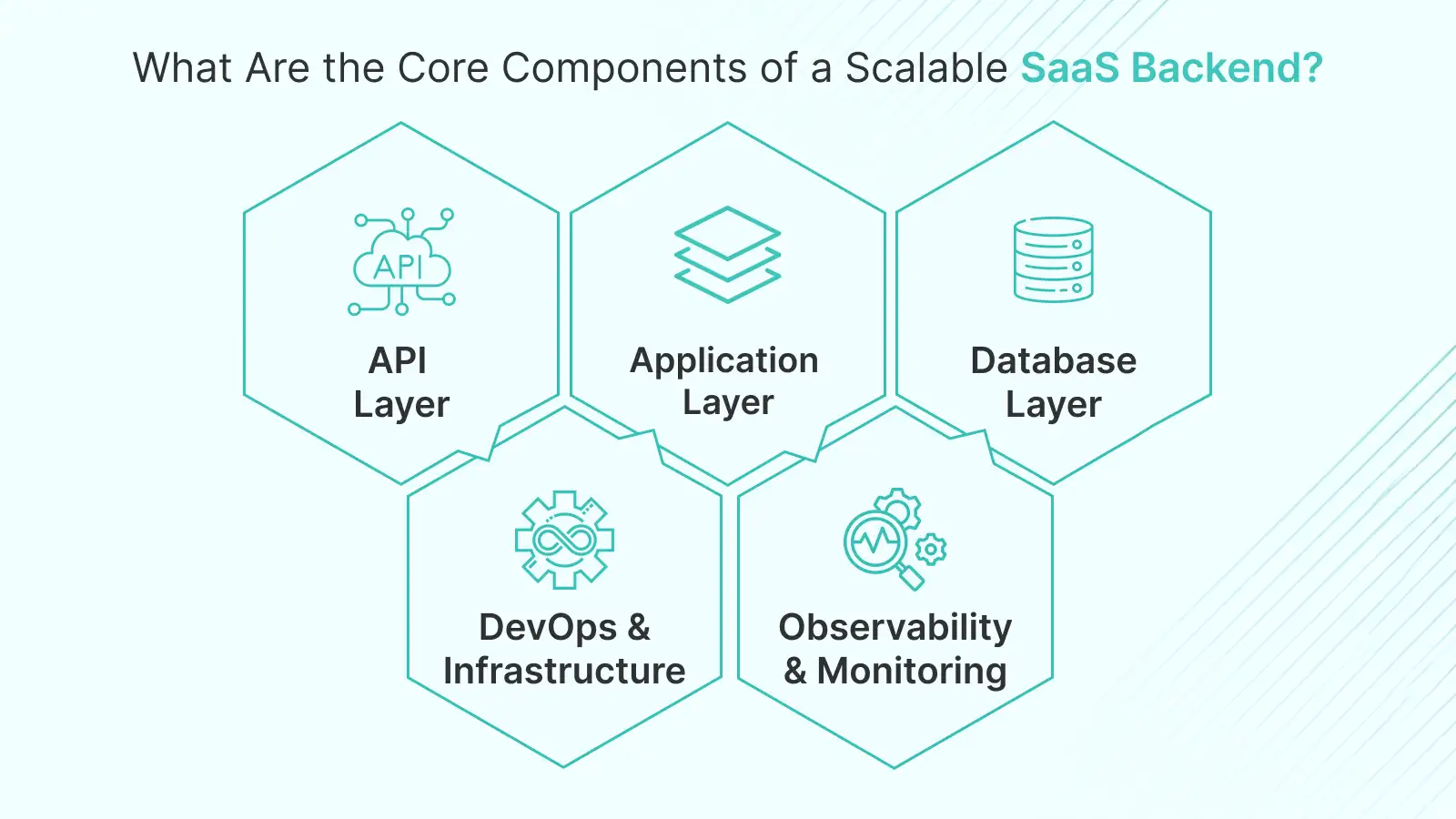
Every layer of a SaaS backend has specific responsibilities that differ from conventional application design. Here is what each one actually does.
API Gateway: The First Line of Every Request
Every request that arrives at the platform passes through the API gateway first. This layer handles:
- Token authentication
- Tenant identification (which customer does this request belong to?)
- Per-tenant rate limiting
- Routing to the correct downstream service
Tenant identification happens via subdomain (acme.yourapp.com), JWT claims, or a custom request header. The gateway has to extract that identity reliably on every single request — because every downstream data access decision depends on it. Miss this at the gateway level, and multi-tenant isolation breaks before a single line of business logic runs.
Authentication vs. Authorization: Two Problems Teams Regularly Conflate
These are not the same thing. Treating them as one is one of the most common and consequential security mistakes in early SaaS development.
Authentication answers: Who is this user? Most SaaS platforms delegate this to an identity provider — Auth0, AWS Cognito, Okta — using OAuth 2.0 and OpenID Connect. The problem is largely solved by off-the-shelf tooling.
Authorization answers: What is this user allowed to do — in their specific tenant? This is the platform’s responsibility. It must be scoped to the tenant level, not just the user level.
Every API endpoint needs both checks. A valid token from Tenant A must never grant access to Tenant B’s resources, even when user roles appear to match. Role-based access control (RBAC) handles most scenarios. Attribute-based access control (ABAC) adds granularity for complex permission models.
Microservices vs. Modular Monolith: The Decision That Defines the Team’s Next Two Years
This debate generates more strong opinions than almost any other architecture topic. Most of them miss the actual point.
The right question is not “monolith or microservices?” The right question is: “what does this team’s current operational maturity actually support?”
Start with a modular monolith. Here is the honest case for it:
- Faster to build and iterate — one codebase, one deployment, one debugging context
- Simpler to trace bugs across the full request lifecycle
- Cheaper to operate — no inter-service network overhead, no distributed tracing complexity from day one
- Easier to refactor, because domain boundaries are still being discovered
Shopify ran on a monolith for years before selectively extracting services. Stack Overflow still does. Basecamp built a highly profitable SaaS product on a single-application architecture. These are not cautionary tales — they are deliberate engineering decisions.
Move to microservices when the business demands it. Specifically, when:
- A specific domain needs to scale independently of everything else
- Separate engineering teams need to deploy without coordinating with each other
- A service has materially different uptime or performance requirements than the rest of the system
The practical approach: build the monolith with clean domain boundaries — billing, notifications, user management, data ingestion. When one of those domains proves it needs independence, extract it. That incremental path is far safer than going microservices-first on a product that is still finding product-market fit.
Data Layer: Where Multi-Tenancy Gets Technically Demanding
The database layer is where most multi-tenant isolation failures actually happen. There are three ways to approach tenant data isolation at the database level.
Shared Schema with tenant_id
All tenants share the same tables. Every row carries a tenant_id column.
Best for platforms with a large number of small tenants. Operationally simple. The risk: every query must include tenant filtering, and a missing clause is a data leakage incident. PostgreSQL’s Row-Level Security (RLS) policies add a database-engine-level safety net — even if application code misses a filter, the database enforces it.
Separate Schemas, Shared Database
Each tenant gets their own schema namespace within a single database server. No tenant_id filtering required in queries. Schema migrations can be applied per-tenant with more flexibility.
Best for medium-size tenant populations with moderate isolation requirements. The trade-off is more complex migration tooling and more schema objects to manage at scale.
Separate Database per Tenant
Each tenant gets their own database instance. Strongest possible isolation. Easy to move high-value tenants to dedicated hardware.
The trade-off: connection pool overhead. Managing connections across hundreds of separate databases without PgBouncer or equivalent tooling wastes resources fast.
For most SaaS platforms, the shared schema approach with PostgreSQL Row-Level Security is the right starting point. Enterprise customers can be migrated to dedicated databases later, when the contract value justifies the operational overhead.
Asynchronous Processing: Keeping the API Response Path Clean
Synchronous HTTP is the right tool for real-time user interactions. It is the wrong tool for almost everything else.
Sending emails, generating reports, processing uploaded files, syncing third-party integrations, triggering webhooks — none of these belong in the API response path. They belong in queue-driven background workers.
An event-driven architecture decouples the service that generates an event from the services that act on it. When a subscription is updated, the billing service publishes an event. The notification service, the audit log service, and the analytics service each consume it independently — without the billing service needing to know those downstream services exist.
The benefits are concrete:
- A downstream service failure does not cascade upstream and break the user’s request
- Background workers scale independently of the API layer
- Services can be tested in isolation against event fixtures rather than live dependencies
Apache Kafka handles high-throughput event streaming. RabbitMQ offers flexible routing for more complex messaging patterns. AWS SQS/SNS is the managed option for teams running primarily on AWS infrastructure.
How Do You Actually Scale a SaaS Backend?
Having a working architecture and having a scalable architecture are different things. Scaling is not something added later — it is a property built into each layer from the start.
Stateless Application Servers: The Non-Negotiable Foundation
Horizontal scaling — adding more server instances behind a load balancer — only works when application servers are stateless.
When a server holds session data in memory, requests have to go back to the same server. Sticky routing. Single points of failure. Scaling becomes complicated and fragile.
When servers are stateless, any request can land on any instance. Adding capacity means adding servers. Removing capacity means removing servers. Neither operation requires downtime or careful coordination.
The rule is simple: session state lives in Redis, not in application memory. Distributed cache lives in Redis, not in application memory. The application server holds nothing between requests.
Caching at the Right Layers
Caching is one of the highest-leverage optimizations available to a SaaS backend. The key is applying it at the right level.
| Layer | Tooling | What It Handles |
| Database | Indexes, query tuning | Eliminating full table scans |
| Application | Redis / Memcached | Frequently read, slowly changing data |
| API | CDN caching | Public or tenant-scoped HTTP responses |
The SaaS-specific rule that often gets missed: every cache key must include the tenant_id. A tenant must never receive another tenant’s cached response. This is a subtle failure mode that can sit undetected for a long time before surfacing as a real data incident.
Read Replicas and Connection Pooling
As read volume grows, the primary database becomes the bottleneck.
Read replicas route all read queries to one or more replica instances while writes still go to the primary. Read capacity scales linearly. Write logic stays simple. This is usually the first scaling move that meaningfully extends a database’s runway.
Connection pooling — PgBouncer is the standard tool for PostgreSQL — manages the overhead of maintaining connections from a large, multi-tenant application. Without it, each application server opening its own connections burns through the database’s connection limit quickly.
When Does Database Sharding Become Necessary?
Sharding distributes data across multiple database instances to handle write throughput that outgrows a single primary.
For SaaS platforms, sharding by tenant_id is the natural approach. Each tenant’s data lives on a single shard, which keeps most queries within one database and makes cross-shard queries rare.
The honest caveat: sharding introduces significant operational complexity — distributed transactions, cross-shard query handling, rebalancing when shards grow unevenly. It should only be reached after read replicas and vertical scaling are genuinely exhausted. Most SaaS products never actually need it.
How Do You Build a SaaS Architecture That Is Genuinely Secure?
Security in a SaaS backend is not a feature layer added on top of a working system. It is a structural property that must be designed in from the beginning — because retrofitting it is far more expensive than building it right.
Enforce Tenant Isolation at the Database Level, Not Just in Application Code
Application-level isolation alone means one bug away from a data breach.
PostgreSQL’s Row-Level Security policies enforce tenant filtering at the database engine itself. If application code sends a query without a tenant filter — whether through a bug or a missing clause — the database returns an empty result rather than leaking data. Isolation failures require both an application bug and a policy bypass to succeed simultaneously.
That is defense in depth. It is the right approach.
Encryption In Transit and At Rest
All connections must use TLS 1.2 or higher. No exceptions. Database storage must use AES-256 encryption at rest.
For platforms handling healthcare data (HIPAA), payment data (PCI-DSS), or EU customer data (GDPR), customer-managed encryption keys (CMEK) are often a contractual requirement from enterprise buyers. Building key management into the architecture early is a fraction of the cost of retrofitting it into a live production system.
Audit Logging Built for Compliance
Every significant data access and modification event should be written to an immutable audit log. SOC 2, GDPR, and HIPAA all require this — and it is a practical necessity for diagnosing security incidents after the fact.
The audit log store should be append-only and write-isolated from the main application database. A compromised application layer must not be able to modify or delete audit records.
Secrets Management Done Properly
SaaS backends accumulate secrets fast: database credentials, API keys, signing keys, third-party integration tokens.
Storing these in environment variables or config files creates risk every time those files touch source control, logging systems, or crash reporters. The right approach is a dedicated secrets manager — HashiCorp Vault, AWS Secrets Manager, or GCP Secret Manager — which serves secrets dynamically to running processes and supports automatic rotation without application restarts.
What Does Cloud-Native SaaS Deployment Actually Look Like?
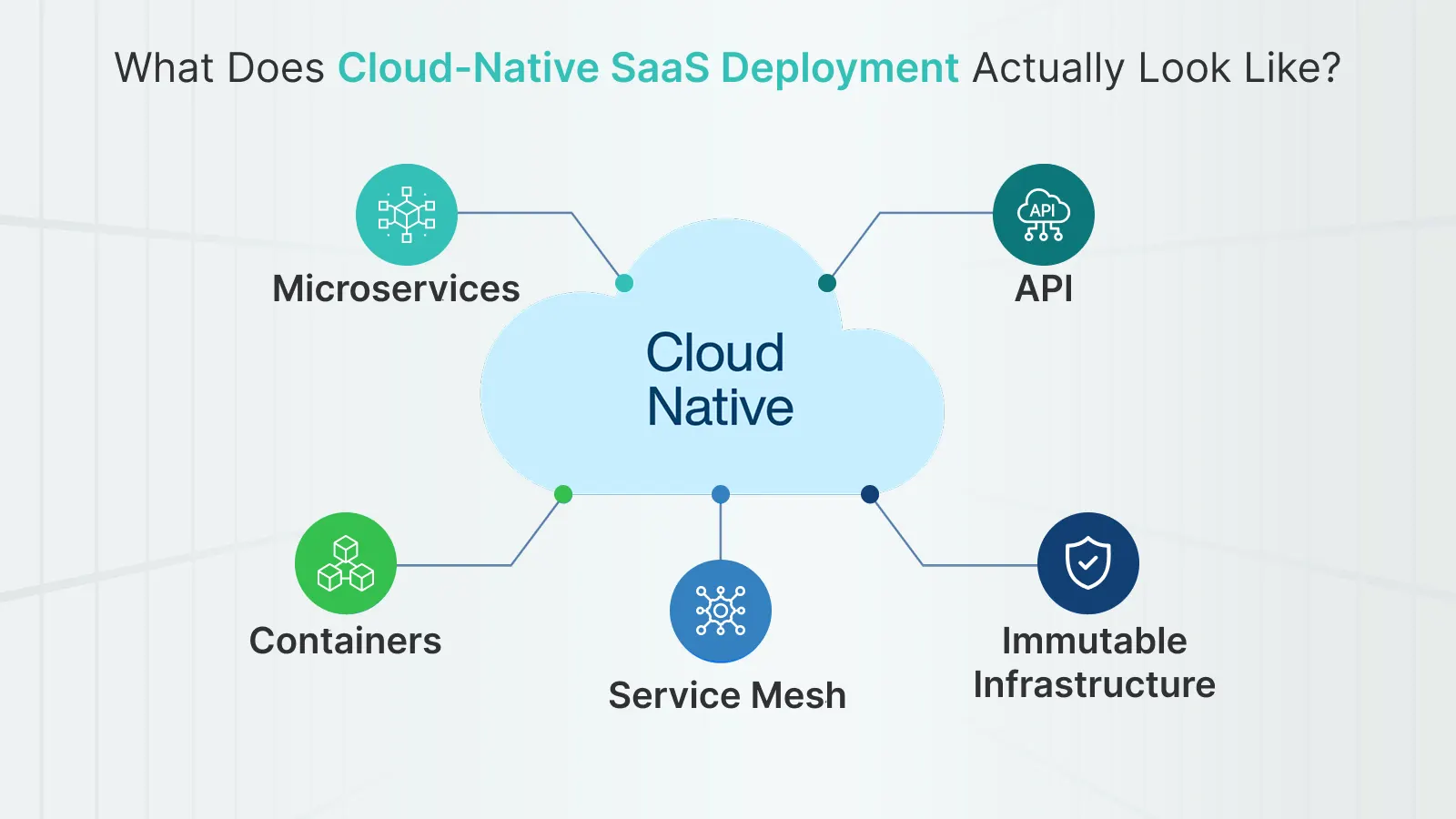
The deployment architecture matters as much as the application architecture. Getting this layer wrong undoes careful work done everywhere else.
Containerization and Kubernetes
Docker containers package the application and its dependencies into a single reproducible artifact. The same container image runs identically across development, staging, and production environments. Environment drift — the “it works on my machine” class of problem — largely disappears.
Kubernetes orchestrates those containers: scheduling them across nodes, scaling horizontally based on load, replacing failed instances automatically, handling rolling deployments with zero downtime.
SaaS-specific patterns worth setting up early:
- Namespace isolation between environments
- Resource quotas to prevent one tenant’s workload from exhausting shared node capacity
- Horizontal Pod Autoscaling triggered by CPU metrics or application-specific metrics like queue depth
Infrastructure as Code
Every infrastructure component — VPCs, databases, Kubernetes clusters, IAM policies, load balancers — should be defined in version-controlled code.
Terraform, Pulumi, and AWS CDK are the standard tools. The benefit is not just reproducibility. It makes infrastructure changes reviewable in pull requests, auditable over time, and recoverable from scratch after a catastrophic failure. Infrastructure managed manually through a console is infrastructure that cannot be fully trusted or fully recovered.
Observability: Metrics, Logs, and Distributed Traces
A SaaS platform that cannot be observed cannot be reliably operated.
The three pillars work together: metrics show aggregate system behavior (request rate, error rate, latency percentiles); logs provide the detailed event trail for debugging specific incidents; distributed traces show how a single request traveled through the full system — which service called which, where time was spent, where failures occurred.
For SaaS specifically, observability must be tenant-aware. When a customer reports slow response times, the team needs to filter metrics and logs by tenant_id immediately — to determine whether the problem is systemic or isolated to that customer’s workload. Without tenant-aware observability, every incident investigation starts with guesswork.
SaaS vs. SOA vs. PaaS: What Is Actually Different?
These three terms appear together constantly and get conflated regularly. The distinction matters.
| Term | What It Actually Describes | Real Examples |
| SaaS | How software reaches customers — subscription-based, delivered over the internet | Slack, Salesforce, Notion |
| SOA | How software is internally structured — as interoperable services | Microservices, ESB-based architectures |
| PaaS | The cloud layer the software runs on — runtime and infrastructure abstracted | Heroku, Google App Engine, AWS Elastic Beanstalk |
A SaaS product can be built using SOA principles and deployed on a PaaS provider. All three are compatible — they describe completely different dimensions of a software system. Conflating them leads to conversations where teams debate delivery model choices as though they were architecture choices, or vice versa.
How Hard Is It to Actually Build a SaaS Application?
This question gets either undersold or oversold depending on who is answering. The honest picture:
What is genuinely hard:
- Multi-tenant data isolation at scale without performance degradation
- Designing for horizontal scalability from day one (most teams skip this and pay for it later)
- Billing and subscription logic that handles every edge case — upgrades, downgrades, failed payments, proration, trial conversions
- Compliance architecture that SOC 2, GDPR, or HIPAA requires at a structural level, not just a policy level
What is more manageable than it appears:
- Authentication and identity — largely solved by off-the-shelf providers
- Deployment and orchestration — managed Kubernetes services remove most of the operational burden
- Monitoring — mature tooling integrates quickly once the instrumentation is in place
Realistic timeline: a small, experienced team can build a production-ready SaaS backend with solid multi-tenancy in three to six months. Reaching enterprise-grade — SOC 2 compliance, high availability guarantees, the operational maturity to support large customers — typically takes another twelve to eighteen months of focused engineering investment.
How to Implement a Scalable SaaS Backend: A Stage-by-Stage Roadmap
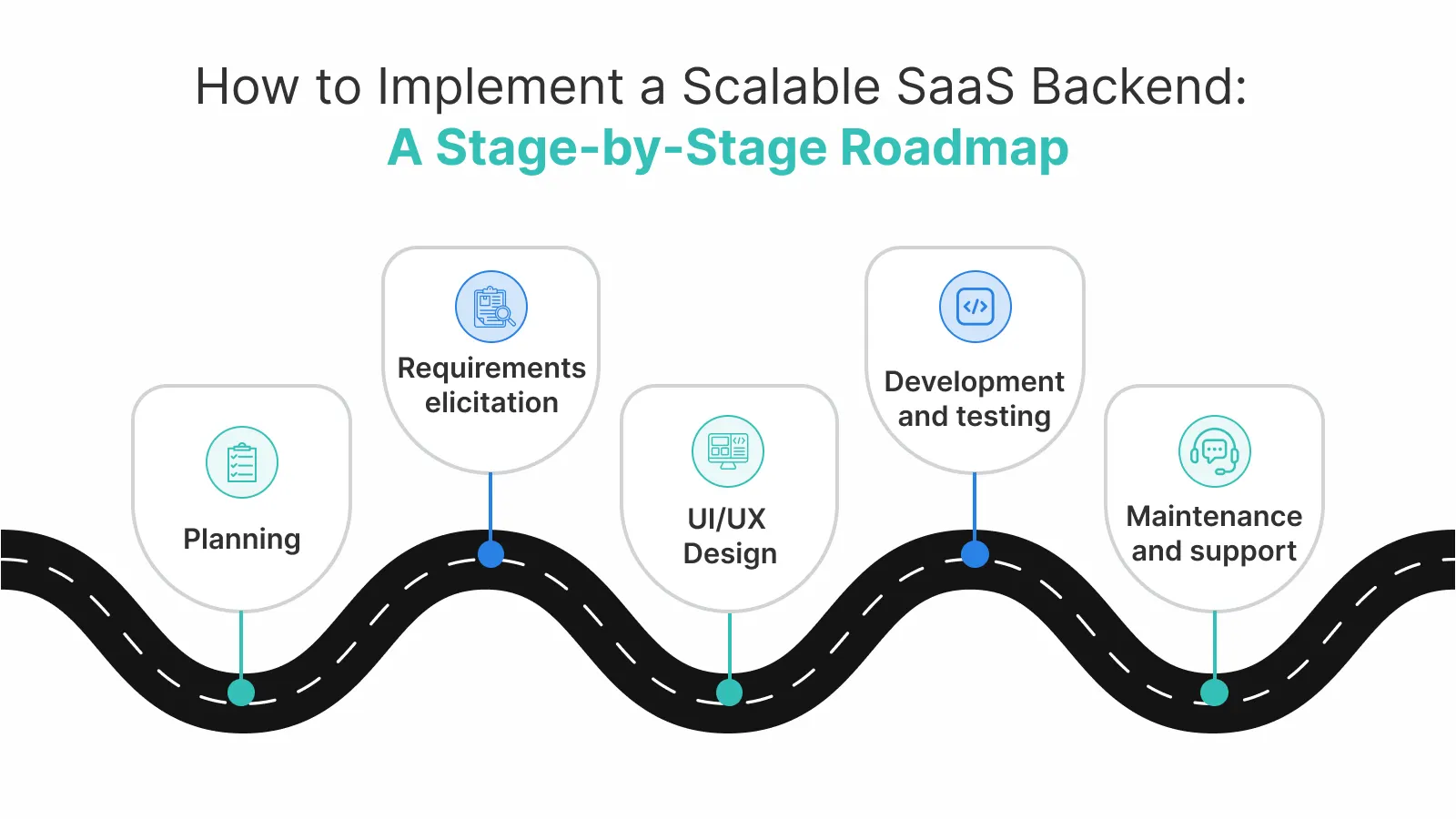
Do not try to implement every pattern at once. Sequence the investments based on where the product actually is.
Stage 1: Foundation (0–10K Users)
At this stage, complexity is the enemy. Get the fundamentals right and leave the optimization for later.
- Choose a tenancy model and enforce it everywhere, consistently
- Implement stateless application servers from day one
- Deploy an API gateway with authentication and per-tenant rate limiting
- Use a shared-schema database with Row-Level Security
- Set up basic logging and error tracking
A modular monolith is almost always the right call here. The pull toward microservices is real — resist it until there is a clear business reason to give in.
Stage 2: Growth (10K–100K Users)
The foundation is proven. Now address the bottlenecks that actually show up in production.
- Move all non-real-time workloads into async queues
- Add Redis caching at the application layer, with tenant-scoped cache keys
- Introduce read replicas for the database
- Implement distributed tracing to find performance hotspots
- Build tenant-aware dashboards and alerting
Stage 3: Enterprise Scale (100K+ Users)
At this stage, complexity is earned — not chosen. Every addition should have a clear business justification.
- Extract services that genuinely need independent scaling into microservices
- Evaluate database sharding if write throughput has outgrown the primary
- Build dedicated infrastructure tiers for enterprise tenants
- Pursue SOC 2 Type II certification and relevant compliance milestones
- Implement customer-managed encryption keys and data residency controls
Key Takeaways
- SaaS backend architecture is fundamentally different from traditional application design — it must serve many tenants simultaneously from shared infrastructure.
- The three tenancy models (single-tenant, multi-tenant, hybrid) each represent a different trade-off between isolation strength, operational cost, and complexity.
- Start with a modular monolith. Move to microservices when the business justifies it — not before.
- Enforce tenant isolation at the database layer, not just in application code. Defense in depth means failures require multiple simultaneous breakdowns.
- Cache keys, audit logs, rate limits, and observability dashboards all need to be tenant-aware.
- Scalability is not a feature added later. It is a structural property that must be present in the architecture from the start.
Conclusion
Scalable SaaS backend architecture is not one decision. It is a series of interconnected choices — about tenancy model, data isolation, service structure, caching, security, and deployment — that compound over time into either a platform that scales cleanly or one that demands a painful rewrite at the worst possible moment.
The teams that get this right share a habit: they make the simplest justifiable decision at each stage and add complexity only when the business actually demands it. They enforce isolation at every layer. They build observability in from the start. And they treat architecture as something that evolves alongside the product — not a blueprint set in stone before the first user has signed up.
Getting these fundamentals right is not about building the perfect system on day one. It is about building a system that can become what it needs to be.
Building or scaling a SaaS product? TechMarcos SaaS development services work with engineering teams on exactly these problems — from architecture review and multi-tenant database design to full-stack SaaS development.
Building a SaaS Product That Can Scale?
From multi-tenant architecture and backend development to cloud deployment, we help startups build SaaS platforms designed for growth.

Amanjeet Singh
Software Engineer

Related SaaS Architecture Resources
Explore more guides on SaaS development, cloud architecture, scalability, and backend engineering.