
Redis Caching Strategies in Production: The Complete Technical Guide for Backend Developers
|
Getting your Trinity Audio player ready...
|
Redis caching strategies in production determine whether your application handles 10,000 requests per second gracefully — or collapses under pressure. This guide covers every major caching pattern, when to use each one, how to configure Redis correctly, and real production examples from companies scaling to billions of operations.
What Are Redis Caching Strategies?
Redis caching strategies are architectural patterns that define how data flows between your application, Redis cache, and primary database. The five core strategies are: Cache-Aside (Lazy Loading), Write-Through, Write-Behind (Write-Back), Read-Through, and Refresh-Ahead. Each solves a different problem — choosing the wrong one causes stale data, cache stampedes, or unnecessary DB load.
Why Redis Caching Strategies Matter in Production {#why-redis}
Most backend developers know Redis is fast. What separates senior engineers is knowing which caching pattern to apply and why. A wrong strategy leads to:
- Cache misses under load → your database gets hammered
- Stale data served to users → wrong prices, outdated inventory
- Cache stampedes → hundreds of threads hitting the DB simultaneously
- Memory bloat → Redis evicting data you actually need
Redis stores all data in memory, delivering sub-millisecond read and write performance. However, that speed advantage only compounds when your caching strategy is correct. BioCatch, for example, handles 40,000 operations per second across 300 million keys — that kind of throughput requires deliberate strategy, not just “add Redis.” The right Redis caching strategy in production will:
- Reduce database load by 60–90%
- Drop average API response times to under 10ms
- Enable horizontal scale without proportional DB cost increases
The 5 Core Redis Caching Strategies {#5-strategies}
| Strategy | Read Source | Write Target | Consistency | Best For |
| Cache-Aside | Cache → DB fallback | App writes to DB | Eventual | General-purpose APIs |
| Write-Through | Cache (always warm) | Cache + DB sync | Strong | Financial, user data |
| Write-Behind | Cache (always warm) | DB async (delayed) | Eventual | High write throughput |
| Read-Through | Cache (transparent) | App writes to DB | Eventual | Read-heavy workloads |
| Refresh-Ahead | Cache (pre-populated) | App writes to DB | Strong-ish | Predictable access patterns |
Cache-Aside (Lazy Loading) {#cache-aside}
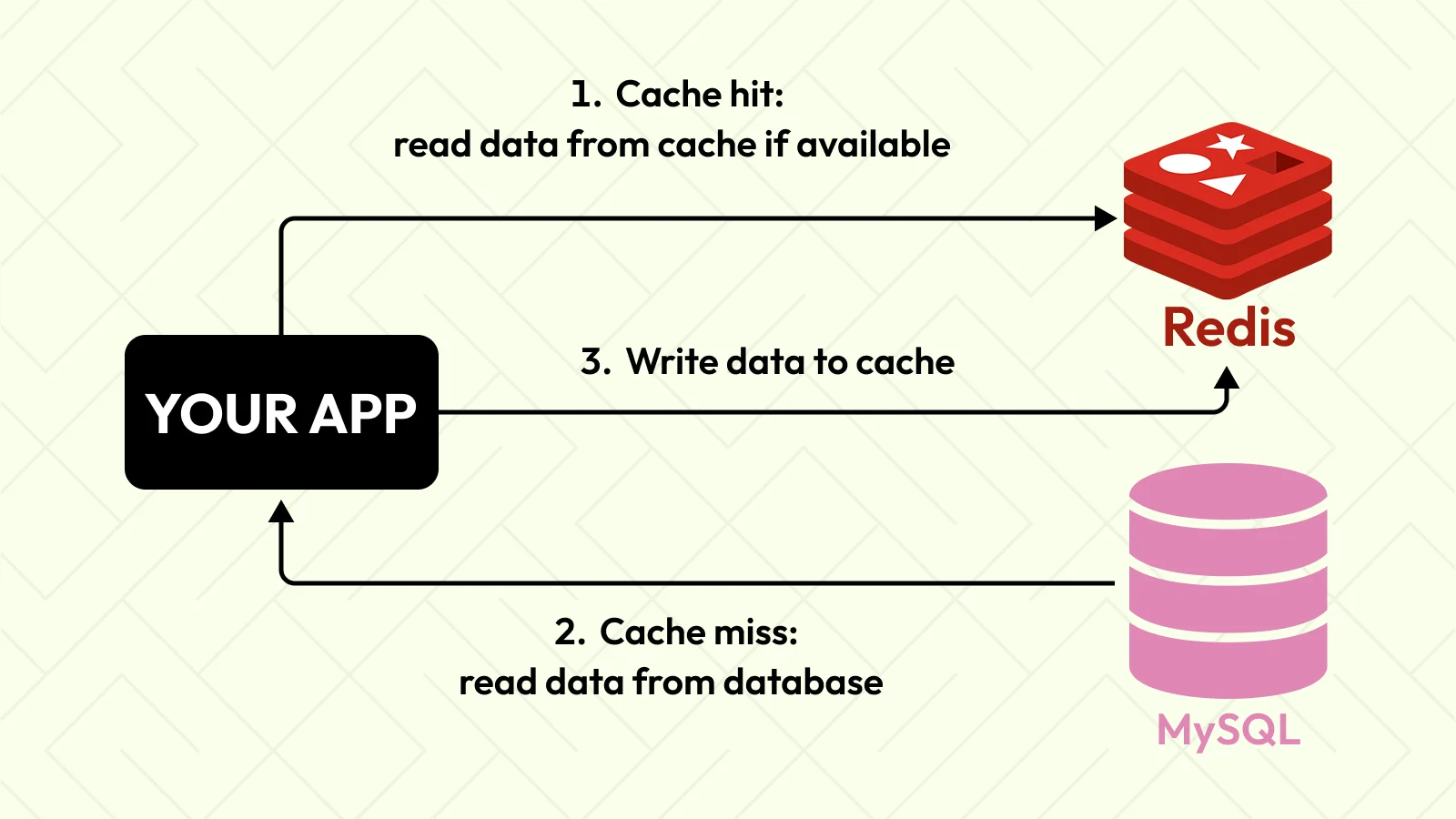
Cache-Aside is the most widely used Redis caching strategy in production. The application is responsible for managing the cache directly — it checks Redis first, falls back to the database on a miss, then populates the cache for future requests.
How It Works
- App receives request for data
- App checks Redis → HIT? Return immediately
- MISS → App queries primary DB
- App writes result to Redis with a TTL
- App returns result to client
Code Example (Node.js + ioredis)
const redis = require('ioredis');
const client = new redis();

async function getUserProfile(userId) {
  const cacheKey = `user:profile:${userId}`;

  // Step 1: Check Redis cache
  const cached = await client.get(cacheKey);
  if (cached) {
    return JSON.parse(cached); // Cache HIT
  }

  // Step 2: Cache MISS — fetch from DB
  const user = await db.query('SELECT * FROM users WHERE id = ?', [userId]);

  // Step 3: Populate cache with 15-minute TTL
  await client.setex(cacheKey, 900, JSON.stringify(user));

  return user;
}
Pros and Cons
Pros:
- Simple to implement and debug
- Cache only contains data that is actually requested
- Resilient: if Redis goes down, the app still works (just slower)
Cons:
- First request always suffers a cache miss (cold start)
- Risk of stale data if DB is updated outside the app
- Can lead to a cache stampede under high concurrency (see section below)
When to Use It
Cache-Aside is ideal for read-heavy workloads with infrequent writes — user profiles, product catalog pages, configuration data, and content feeds.
Write-Through Caching {#write-through}
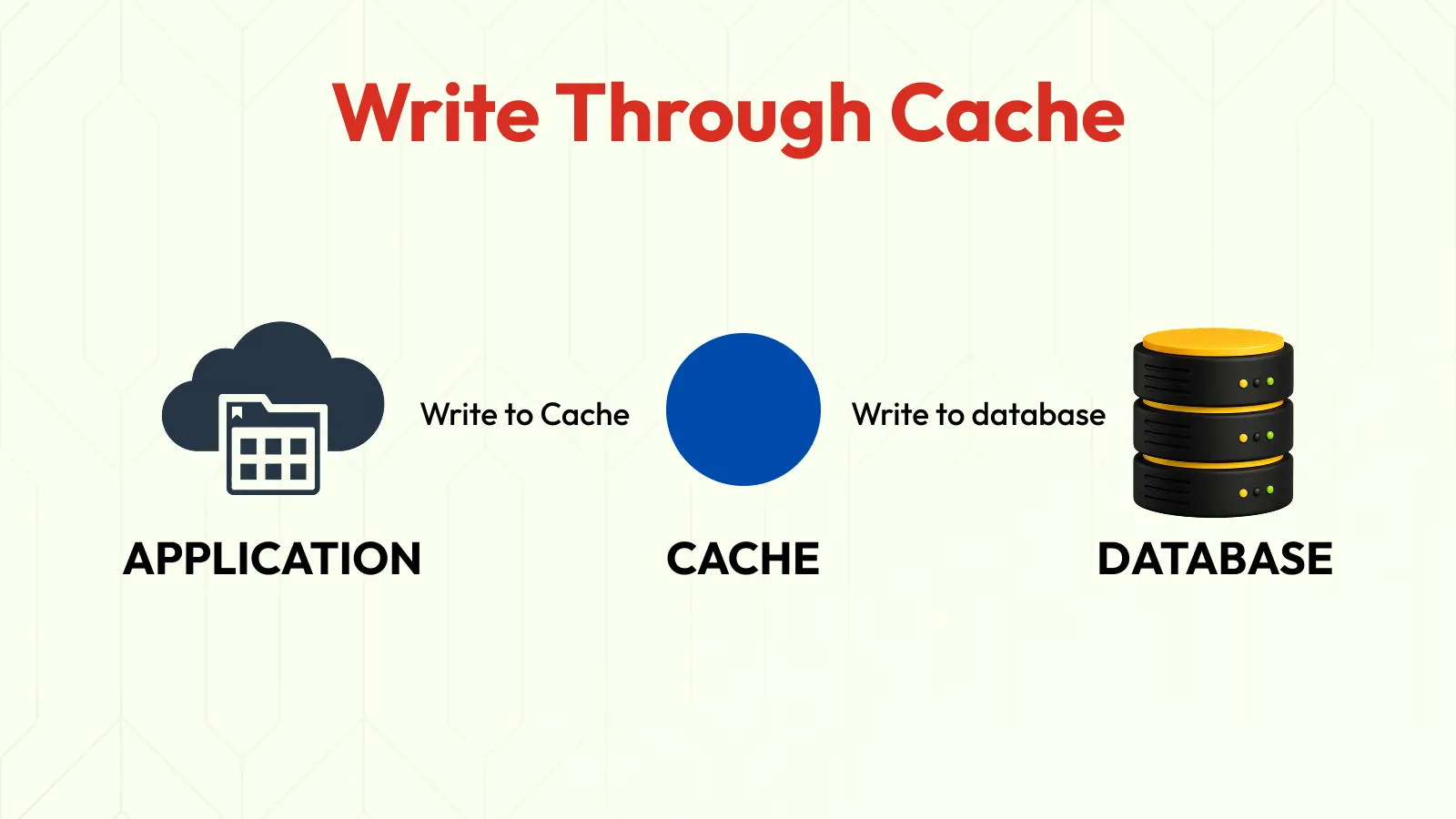
In Write-Through caching, every write goes to Redis and the database simultaneously. The cache is always in sync with the source of truth.
How It Works
- App writes data
- App writes to Redis
- App writes to primary DB (synchronously)
- Both succeed → return success to client
Code Example
async function updateUserProfile(userId, data) {
  const cacheKey = `user:profile:${userId}`;

  // Write to DB first
  await db.query('UPDATE users SET ? WHERE id = ?', [data, userId]);

  // Immediately update Redis cache
  await client.setex(cacheKey, 900, JSON.stringify(data));

  return { success: true };
}
Pros and Cons
Pros:
- Cache is always consistent with the database
- No stale reads
- Eliminates cold-start misses on recently written data
Cons:
- Higher write latency (two writes per operation)
- Cache may fill with data that is rarely read (write amplification)
- If Redis fails during a write, you need careful error handling
When to Use It
Use Write-Through for data where consistency is non-negotiable — financial transactions, user authentication tokens, session data, and inventory counts.
Write-Behind (Write-Back) Caching {#write-behind}
Write-Behind decouples your cache from your database. The application writes only to Redis. A background process then asynchronously flushes those writes to the primary database.
How It Works
- App writes to Redis immediately → returns success
- Background worker picks up queued writes
- Worker flushes batched writes to DB asynchronously
Pros and Cons
Pros:
- Extremely low write latency (one in-memory write)
- Ideal for high-frequency write workloads (IoT, analytics, logging)
- Reduces DB connection pressure significantly
Cons:
- Risk of data loss if Redis crashes before flush completes
- More complex to implement and monitor
- Harder to debug consistency issues
When to Use It
Write-Behind fits analytics pipelines, event counters, IoT data ingestion, and leaderboard updates where slight data loss is tolerable. Inovonics uses a similar pattern to handle millions of daily sensor messages before persisting to their primary store.
Read-Through Caching {#read-through}
Read-Through is conceptually similar to Cache-Aside, but the cache itself is responsible for fetching data from the DB on a miss — not the application. This is typically implemented via a caching library or a Redis module like RedisGears.
How It Works
- App requests data from cache
- Cache HIT → return data
- Cache MISS → cache fetches from DB automatically
- Cache stores and returns the data
When to Use It
Read-Through works best when you want transparent caching with minimal application-layer changes. It is often paired with Redis Smart Cache or JDBC-compliant middleware in microservice architectures.
Refresh-Ahead Caching {#refresh-ahead}
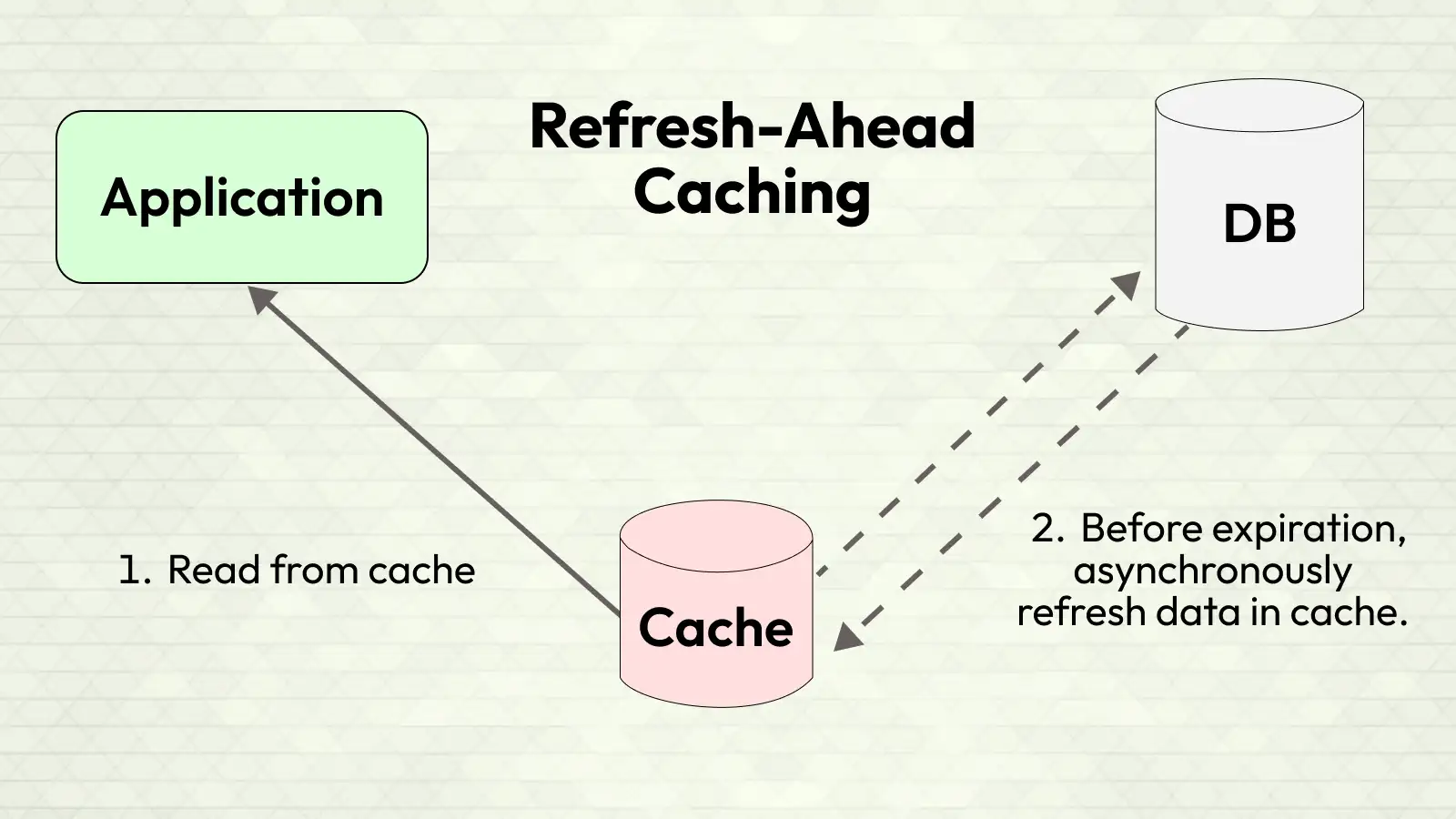
Refresh-Ahead proactively refreshes cache entries before they expire. The system monitors TTL and pre-populates the cache slightly ahead of expiration.
How It Works
- Data is cached with TTL = 60 seconds
- At ~80% of TTL (48s), background job refreshes the entry
- User never experiences a cache miss
When to Use It
Refresh-Ahead is ideal for high-traffic data with predictable access patterns — homepage content, global configuration, top product listings, or session data for active users. The tradeoff: you may cache data that users stop requesting, wasting memory. Always monitor hit rates.
Choosing the Right TTL in Production {#ttl}
TTL (Time to Live) is one of the most important — and most often mistuned — Redis settings in production.
TTL Guidelines by Data Type
| Data Type | Recommended TTL | Reasoning |
| User session | 15–30 minutes (sliding) | Balance security and UX |
| Product catalog | 5–15 minutes | Inventory changes frequently |
| User profile | 10–60 minutes | Rarely changes |
| Homepage content | 1–5 minutes | High traffic, needs freshness |
| Auth tokens | Match token expiry | Security requirement |
| Rate limit counters | 1 second–1 minute | Short-lived by design |
| Config/feature flags | 5–10 minutes | Near-real-time propagation |
Key Principles
- Never cache without a TTL. Unbounded cache growth causes OOM errors and unpredictable evictions.
- Use sliding TTL for sessions. Reset the expiry on each access with EXPIRE key seconds.
- Stagger TTLs. If 10,000 keys all expire at the same second, you get a synchronized cache miss storm. Add random.randint(0, 30) seconds to TTLs.
// Staggered TTL to prevent cache stampedes
const baseTTL = 900;
const jitter = Math.floor(Math.random() * 60);
await client.setex(cacheKey, baseTTL + jitter, JSON.stringify(data));
Redis Eviction Policies Explained {#eviction}
When Redis runs out of memory, it must evict keys. The wrong eviction policy silently degrades your cache performance in production.
Redis Eviction Policies
| Policy | What Gets Evicted | Use Case |
| noeviction | Nothing (returns error) | When data loss is unacceptable |
| allkeys-lru | Least recently used key (any) | General-purpose caching |
| volatile-lru | Least recently used key with TTL | Mixed session + persistent data |
| allkeys-lfu | Least frequently used key (any) | Skewed access patterns |
| volatile-ttl | Key with soonest expiration | Session-heavy applications |
| allkeys-random | Random key | Rarely recommended |
Production Recommendation
For most caching workloads, use allkeys-lru. It evicts the least recently used key from the entire keyspace, ensuring your hot data stays in memory. # Set in redis.conf maxmemory 4gb maxmemory-policy allkeys-lru Always set maxmemory. Without it, Redis will consume all available server RAM.
Cache Stampede: How to Prevent It {#stampede}
A cache stampede (also called “thundering herd”) occurs when a popular cache key expires and hundreds of concurrent requests all miss simultaneously — all racing to query the database. This is one of the most dangerous production failure modes for Redis caching.
Prevention Strategy 1: Mutex Locking
Use a Redis distributed lock to allow only one thread to fetch from the DB. All others wait.
async function getWithLock(cacheKey, fetchFn, ttl) {
  const cached = await client.get(cacheKey);
  if (cached) return JSON.parse(cached);

  const lockKey = `lock:${cacheKey}`;
  const lock = await client.set(lockKey, '1', 'NX', 'EX', 5); // 5s lock

  if (!lock) {
    // Another process is fetching — wait and retry
    await new Promise(r => setTimeout(r, 100));
    return getWithLock(cacheKey, fetchFn, ttl);
  }

  try {
    const data = await fetchFn();
    await client.setex(cacheKey, ttl, JSON.stringify(data));
    return data;
  } finally {
    await client.del(lockKey);
  }
}
Prevention Strategy 2: Probabilistic Early Expiration (XFetch)
Refresh the cache slightly before it expires, with probability proportional to how close it is to expiry. This avoids the hard cliff of simultaneous expiry.
Prevention Strategy 3: Background Refresh
Never let a key expire. Use a background job to continuously refresh it. The application always reads from cache and never triggers a DB fetch directly.
Redis vs Memcached: Which Should You Cache With? {#vs-memcached}
This is one of the most searched Redis comparisons on Google — and the answer depends on your use case.
| Feature | Redis | Memcached |
| Data structures | Strings, Hashes, Lists, Sets, Sorted Sets, Streams, JSON | Strings only |
| Persistence | Yes (RDB + AOF) | No |
| Pub/Sub | Yes | No |
| Cluster support | Yes (Redis Cluster) | Yes (client-side) |
| Lua scripting | Yes | No |
| Geospatial support | Yes | No |
| Memory efficiency | Good | Slightly better for pure strings |
| Replication | Yes (Redis Sentinel) | No built-in |
Bottom line: Use Redis unless you are building a dead-simple string cache with zero persistence requirements and want to squeeze the last drop of memory efficiency. For any production backend with sessions, leaderboards, rate limiting, or pub/sub — Redis wins.
Real-World Redis Caching Architectures {#real-world}
E-Commerce: Gap Inc.
Gap Inc. implemented Redis to serve real-time inventory and shipping data to their e-commerce platform. Before Redis, delayed and inaccurate inventory information was causing cart abandonment and order cancellations. With Redis Enterprise, they achieved sub-millisecond performance at scale — critical during Black Friday traffic peaks where their microservice architecture needed to avoid over-provisioning. Pattern used: Cache-Aside for product/inventory reads + Write-Through for cart data
Gaming: Scopely (The Walking Dead)
Scopely, which builds mobile games with millions of concurrent users, relies on Redis for leaderboards (Sorted Sets), API rate limiting, and queue workload management. Mobile games require sub-10ms response times — a single slow database call ruins the user experience. Pattern used: Write-Behind for leaderboard score updates + Sorted Sets for real-time ranking
Fraud Detection: BioCatch
BioCatch processes 40,000 operations per second across 300 million Redis keys, running on Microsoft Azure. They store behavioral biometric profiles and fraudulent behavior patterns in Redis to make fraud decisions in under 40 milliseconds — before a transaction completes. Pattern used: Read-Through with Redis as primary store, not just cache
SaaS: Freshworks
Freshworks uses Redis as a frontend cache for their MySQL database, stores background job queues, and uses HyperLogLog for user analytics. As they migrated to microservices, Redis became their session store and API rate limiter. Pattern used: Cache-Aside + Write-Through for session management + Rate limiting counters
How to Implement Redis Caching Strategies in Node.js {#nodejs}
Here is a production-ready Redis caching service class that supports multiple strategies:
const redis = require('ioredis');

class RedisCacheService {
  constructor(options = {}) {
    this.client = new redis(options.redisUrl || process.env.REDIS_URL);
    this.defaultTTL = options.defaultTTL || 900;
  }

  // Cache-Aside pattern
  async cacheAside(key, fetchFn, ttl = this.defaultTTL) {
    const cached = await this.client.get(key);
    if (cached) return JSON.parse(cached);

    const data = await fetchFn();
    const jitter = Math.floor(Math.random() * 30);
    await this.client.setex(key, ttl + jitter, JSON.stringify(data));
    return data;
  }

  // Write-Through pattern
  async writeThrough(key, data, persistFn, ttl = this.defaultTTL) {
    await persistFn(data); // Write to DB first
    await this.client.setex(key, ttl, JSON.stringify(data));
    return data;
  }

  // Invalidate cache entry
  async invalidate(key) {
    await this.client.del(key);
  }

  // Invalidate by pattern (use sparingly in production)
  async invalidatePattern(pattern) {
    const keys = await this.client.keys(pattern);
    if (keys.length > 0) {
      await this.client.del(...keys);
    }
  }

  // Rate limiter using Redis counters
  async rateLimit(identifier, limit, windowSeconds) {
    const key = `ratelimit:${identifier}`;
    const current = await this.client.incr(key);

    if (current === 1) {
      await this.client.expire(key, windowSeconds);
    }

    return {
      allowed: current <= limit,
      remaining: Math.max(0, limit - current),
      reset: windowSeconds,
    };
  }
}

module.exports = RedisCacheService;
Usage
const cache = new RedisCacheService({ defaultTTL: 600 });

// Cache-Aside
const user = await cache.cacheAside(
  `user:${userId}`,
  () => db.findUserById(userId)
);

// Write-Through
await cache.writeThrough(
  `user:${userId}`,
  updatedUser,
  (data) => db.updateUser(userId, data)
);

// Rate limiting
const result = await cache.rateLimit(`api:${ip}`, 100, 60);
if (!result.allowed) {
  return res.status(429).json({ error: 'Too many requests' });
}
Redis Caching Best Practices for Production
Before deploying any Redis caching strategy, make sure you have these fundamentals in place: Key Naming Conventions Always use structured, namespaced keys:
{service}:{entity}:{id}:{subfield}
user:profile:12345
product:detail:98765:pricing
session:auth:token:abc123
Connection Pooling Never create a new Redis connection per request. Use a shared client with connection pooling:
{service}:{entity}:{id}:{subfield}
user:profile:12345
product:detail:98765:pricing
session:auth:token:abc123
Monitor Cache Hit Rates A healthy production cache should have a hit rate above 85%. Monitor with:
redis-cli info stats | grep keyspace_hits
redis-cli info stats | grep keyspace_misses
Enable Redis Persistence (AOF) For production workloads where cache warm-up is expensive, enable AOF persistence to survive restarts: appendonly yes appendfsync everysec
Key Takeaways {#takeaways}
- Cache-Aside is your default strategy for read-heavy APIs. Simple, resilient, and widely supported.
- Write-Through ensures consistency for critical data like sessions and financial records.
- Write-Behind optimizes high-frequency writes at the cost of some durability risk.
- Always set TTLs — never let Redis grow unbounded in production.
- Add jitter to TTLs to prevent synchronized cache miss storms.
- Use allkeys-lru eviction for general-purpose production caches.
- Protect hot keys with mutex locks or background refresh to prevent stampedes.
- Monitor hit rates continuously — a dropping hit rate is an early warning sign.

Saurabh Sharma
Sr. Software Engineer



Related Articles
Discover more expert guides on Redis, backend architecture, caching strategies, and scalable system design.