
Professional Cannabis Website Design: A Complete Guide for Brand Owners

The process of establishing a cannabis brand on a web page is completely unlike the establishment of nearly any other industry. The issues are way beyond design beauty or user experience. The cannabis websites are in the legal gray zone where any slip in compliance could lead to the closure of the site, the ban of payment processors, or even worse.
This guide discusses what a professional cannabis website design entails, what technical and legal considerations you should take into consideration, and how to measure whether a site, yours or that of a competitor, has been designed to be sustainable in this industry.
Why Cannabis Websites Face Unique Challenges
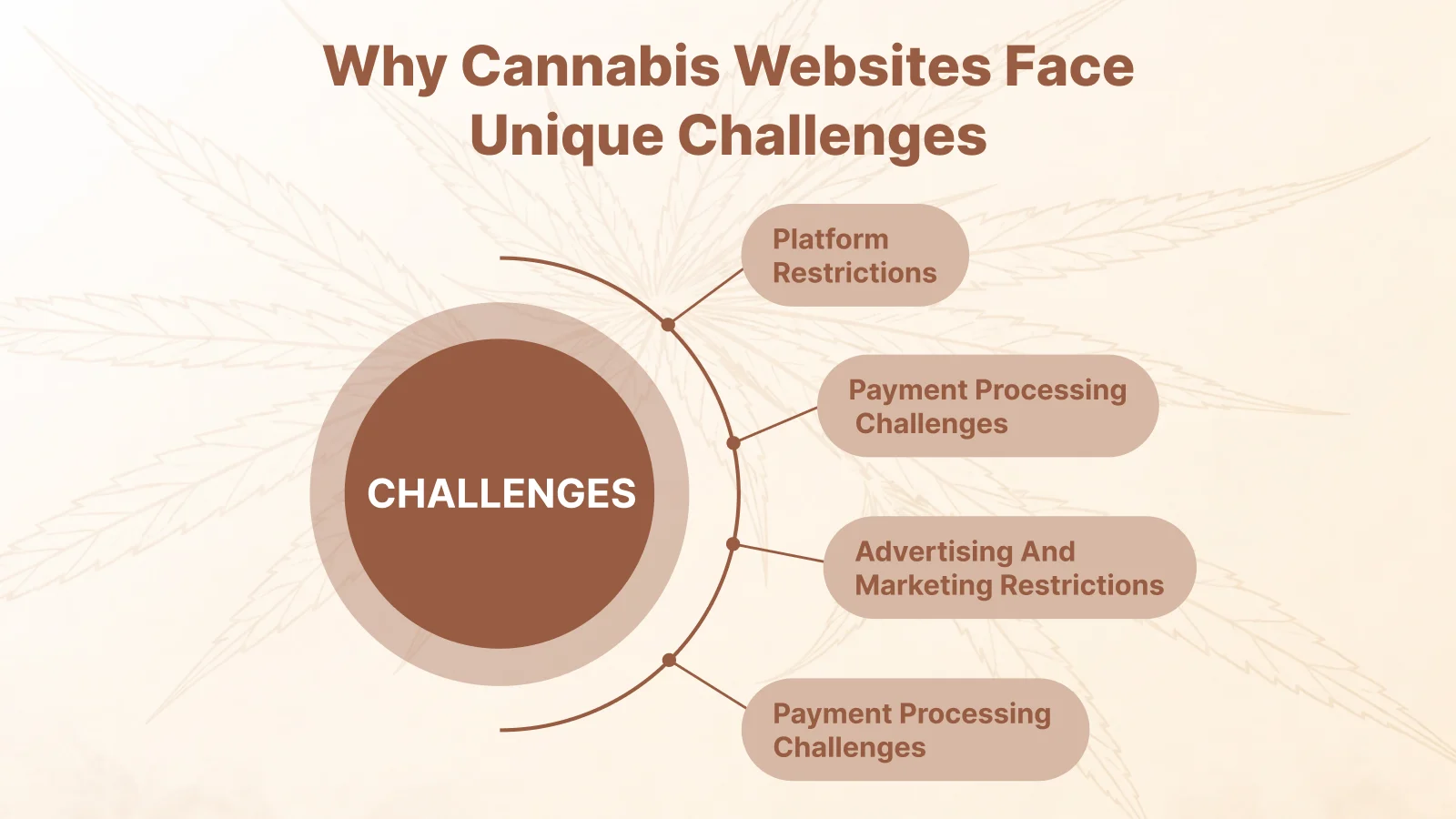
Even though individual states have legalized cannabis as a medical and recreational drug, it remains federally illegal in the United States. This forms a quilt of laws that shift depending on your customers, the goods that you are selling and how you are selling them.
Here are the core challenges every cannabis website must navigate.
Platform Restrictions
The majority of ecommerce platforms in the mainstream do not allow cannabis at all or place it under heavy restrictions. An example of this is the sale of CBD and THC products, which Shopify disallows in its terms of service, and will close without warning in the event it discovers cannabis-related information on its site.
It implies that cannabis brands should not use the ready-to-go solutions. The latter require platforms that are based on open-source solutions such as WooCommerce or entirely custom frameworks that do not enforce blanket bans on the types of items traded.
Payment Processing Challenges
Banks and payment processors consider cannabis to be high-risk due to its federal nature. Cannabis merchant account will be rejected by many processors. The ones that do tend to charge many, rolling reserves or freezing of accounts on a whim when they feel your business is going against their terms.
Your site should be tied in with payment gateways that specifically accept cannabis payments. Other standard Stripe or PayPal integrations will not be possible. Depending on their market, cannabis brands usually employ specialized processors such as Aeropay, Dutchie Pay, or even traditional cash-on-delivery systems.
Advertising and Marketing Restrictions
Google Ads bans most cannabis advertising. Facebook and Instagram restrict it heavily. This means cannabis brands cannot rely on paid traffic the way other ecommerce businesses do. Your website becomes your primary marketing channel by default.
This is considered by professional cannabis web design which incorporates solid organic search engine optimization, content marketing platforms and conversion-oriented landing pages that do not rely on paid advertising.
State-Specific Compliance Requirements
Laws of marijuana are extremely different across states. There are dissimilar age checking rules. Shipping enforced. In certain states, online cannabis sales with delivery are legal, and in others, it is banned completely. These variations should be automatically managed on a professional cannabis site as opposed to manual management.
This is the point of failure of most generic web agencies. They develop a site that will work in one state and expect it to work everywhere. It will not.
What Professional Cannabis Website Design Actually Includes
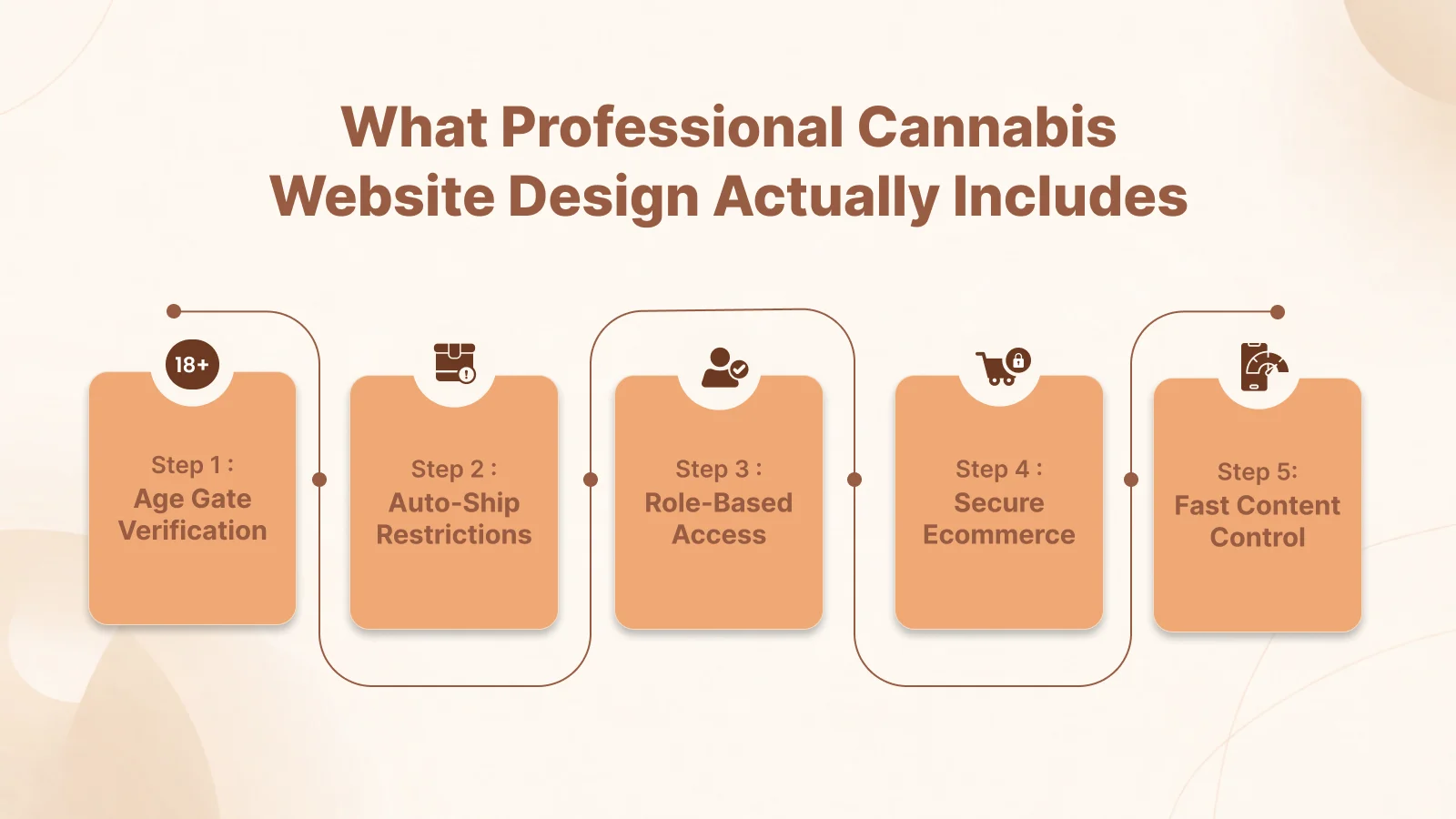
The appearance of a professional cannabis site is not determined by its appearance. It is characterized by the structures constructed within its foundation which enable it to work legally, safely, and effectively in various markets. Here is what that looks like in practice.
Age Verification Systems
All cannabis websites should have an age gate whereby any visitor must be of age before the site is accessed. Such is not a choice, but rather a legal mandate in all the states where cannabis is being sold.
The problem is to introduce the age verification in a manner that should be acceptable and does not worsen the user experience. Having a poorly designed age gate will be a friction on the part of a potential customer who may be at the point of making a decision on whether to remain at your site or not.
There are a number of considerations in professional implementation. Age gate must come out prior to any product content loading. It must need a date of birth entry or a government ID check based on state mandates. And it ought to remember verification, so that visitors do not get asked again.
Other cannabis brands put the age gate as a brand experience and not a legal box. Branded imagery, animated effects, and creative communication can transform a mandatory into an experience that will reinforce your identity, instead of disrupting it.
Automated Shipping Restrictions
Cannabis cannot legally be shipped to all locations. Even within states where cannabis is legal, certain counties or municipalities prohibit delivery. Your website needs to know where customers are located and block orders from restricted areas before they reach checkout.
Manual monitoring does not work. By the time you catch a prohibited order, the customer has already entered payment information, received a confirmation email, and expects delivery. Cancelling the order creates a bad experience and exposes your business to compliance risk.
Address verification is provided in real time on professional cannabis websites. When a customer enters the shipping address, the system is used to compare the shipping address with a database of restricted addresses. In case the address is not allowed, the customer is informed first before he or she does. This helps to avoid cases of non-compliance and unnecessary post purchase cancellations.
Role-Based Access for Wholesale and Retail
There are numerous cannabis brands, which sell to consumers and other businesses. The wholesale customers have varying prices and higher orders and conditions that do not appear on the retail investors.
A professional system handles this through role-based access. When a wholesale buyer logs in, they see wholesale pricing and products automatically. Retail customers see standard pricing. No manual switching, no separate websites to manage.
There is also protection of security in data. Cannabis companies deal with sensitive customer data such as purchase history that would be used against them in the states where cannabis is not legal. It is necessary to have proper encryption, security hosting, and architecture dedicated to privacy.
Security Infrastructure for High-Risk Ecommerce
Websites that deal with cannabis are more likely to get unwanted traffic in comparison to normal online stores. Bots make account takeovers. Stealing credit card fraudsters put their cards to the test. Price scraping by competitors.
The professional cannabis websites do not add security later, but they develop it as the core. This incorporates the CAPTCHA systems which prevent the bots but not the real users, the rate limiting to thwart the brute force attacks, and the fraud detection rules and rules together with the payment processing.
Security is also expanded to information protection. Cannabis companies deal with sensitive data on customers such as purchase history that might be used against them in illegal cannabis states. It requires proper encryption and security hosting as well as privacy-oriented architecture.
Content Management Systems Built for Marketing Speed
Brands of cannabis must be moving speedy. New products, time-limited offers, and seasonal advertising need prompt implementation. When your marketing team has to wait two weeks to get a developer to create a landing page, you will miss out.
Professional cannabis sites come with content management tools that provide non-technical teams with the empowerment to create pages, update content, and roll out campaigns without having to involve more technical personnel. This is usually done by visual page builders or custom templates which offer structure without any knowledge of code.
The outcome is speed of operation. Marketing is able to test ideas rapidly, iterate over outcomes and react to market changes without causing bottlenecks in the development queue.
Common Mistakes Cannabis Brands Make When Building Websites
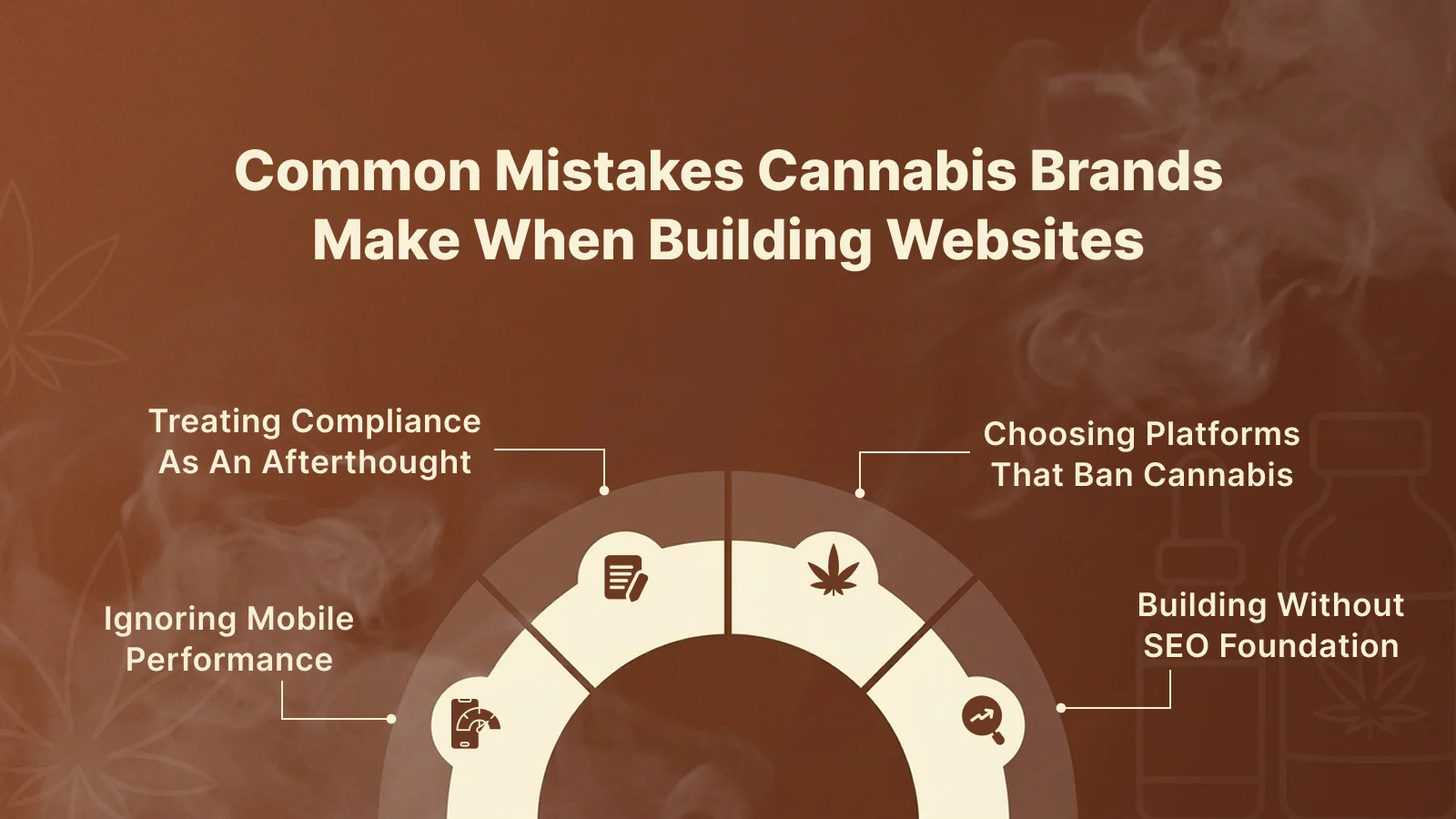
Even those brands that have invested in professional design tend to commit strategic errors that work against the effectiveness of their websites. Here are the most common ones.
Treating Compliance as an Afterthought
Most cannabis brands build their site and then consider compliance. They select a beautiful theme, develop their product pages and then attempt to understand how to introduce age checking and shipping limits without ruining the design.
Issues are ensured by this approach. The compliance needs have an impact on site structure, user experience and data management. Once you attach them afterwards, you have heavyweight experiences and technical debt that accrues over time.
The development of professional cannabis websites is based on compliance requirements and is developed around them. The architecture is informed by age gate, shipping logic and data privacy rules at the very beginning.
Choosing Platforms That Ban Cannabis
Shopify is the worldwide most popular online store. It is also among the poorest cannabis brands since it prohibits directly the sale of cannabis in its terms of its service.
Shopify is a simple and conveniently supported brand. They are then choked with no notice and are deprived of everything in their stores, customer information and order history. The cost of switching to another platform increases exponentially when compared to the initial choice of a platform.
The most popular substitute of cannabis ecommerce is WooCommerce. It is open-source, and it is based on WordPress without any limitations on the content. Others may be tailor-made or new cannabis-oriented platforms such as Dutchie.
Ignoring Mobile Performance
The majority of cannabis shoppers shop and buy through mobile gadgets. When your site loads slow, has a clumsy menu or needs a lot of scrolling and zooming on a phone, you are losing sales.
Nature of Cannabis websites, they are not geared towards mobile performance since they pay more emphasis on visual representation rather than on speed. The huge images, heavy use of animation, and code that is not optimized deliver beautiful desktop experience that crawls on mobile.
Aesthetics is set against performance by professional development. The pictures are compressed and loaded on demand. Mobile is optimized or disabled, with animations. The most important content is loaded initially as the insignificant items load gradually.
Building Without SEO Foundation
The fact that cannabis brands cannot count on Google Ads, or social media advertising makes such a search their main method of attracting customers. A cannabis site that lacks a good SEO is not visible.
Cannabis optimization needs more than the fundamental optimization. Keywords to do with cannabis are competitive. The content should be well-designed and should not cause spam filters to go off and prevent the content to rank with the relevant searches. Technical SEO site speed, mobile optimization, structured data gets even more critical when you are not able to buy your way into the limelight.
Professional cannabis sites are designed on the basis of incorporating SEO, and not as an added feature as a plug in.
How to Evaluate a Cannabis Website (Yours or a Competitor’s)
Whether you are reviewing your own site or researching competitors, here is how to assess whether a cannabis website is professionally built.
Test the Age Gate
Is the age gate presented prior to any content of the product loading? Is it functional on mobile? And is it memory enabled so that returning visitors do not need to be asked again and again? When any of these collapse, compliance was not a priority when constructing the site.
Try Ordering to a Restricted Location
Enter a shipping address in a state where cannabis delivery is prohibited. Does the site catch it before checkout? If you can add items to cart and proceed through payment before being stopped, the shipping restriction system is inadequate.
Check Mobile Performance
Test on a slower connection phone load site. Does it feel fast or sluggish? Simple to use or must the design be zoomed to? Professional and amateur sites perhaps differ there the most, in mobile experience.
Look for Signs of Custom Development
The methods to find generic template sites include repetition of design, stock images or generic text. Bespoke websites are brand-specific and their features are specific to their needs and not the recycled templates.
Review Their Content Strategy
Is there blog writing, education materials or product instructions on the site? Or is it product pages and a contact form only? The engagement of cannabis brands in content reveals that they have the long-term strategy of organic growth and do not expect instant victory.
What Cannabis Website Design Costs and Why
Cannabis website pricing varies widely based on complexity and the level of customization required. Understanding what drives cost helps you evaluate whether you are getting value or overpaying.
Template-based sites cost less because they start with pre-built designs and standard functionality. You can launch a basic cannabis website for a few thousand dollars using WordPress, a premium theme, and plugins for age verification and compliance.
The tradeoff is flexibility. Templates are built for generic use cases. Customizing them to handle cannabis-specific requirements often requires workarounds that create technical debt. You save money upfront but pay later when you need features the template cannot support.
Semi-custom sites balance cost and flexibility. They start with a framework but include custom development for compliance features, integrations, and brand-specific design. Most professional dispensaries and cannabis brands fit in this category.
Fully custom sites provide maximum control but require the largest investment. You define every aspect of functionality, design, and user experience. This approach makes sense for brands with complex requirements — multi-state operations, B2B and B2C sales, custom integrations with inventory or compliance systems.
The key is matching your investment to your actual needs. A local dispensary with a single location does not need a fully custom platform. A multi-state brand selling wholesale and retail across different regulatory environments probably does.
Building for the Long Term in a Changing Industry
Cannabis regulations will continue evolving. New states will legalize. Federal policy may shift. Payment processing standards will change. Your website needs to adapt without requiring a complete rebuild every time the landscape shifts.
This is why professional cannabis website design emphasizes flexibility and maintainability over short-term cost savings. Open-source platforms like WooCommerce can be updated and extended as requirements change. Custom-built systems can be modified without dependence on a single vendor.
Think of your website as infrastructure, not a project. You are not building something that gets finished and forgotten. You are building a platform that will evolve with your business and the industry.
Key Takeaways
Professional cannabis website design is defined by compliance infrastructure, not visual polish. Age gates, shipping restrictions, payment processing, and security systems must be built into the foundation.
Platform choice matters more in cannabis than in most industries. Choose systems that explicitly allow cannabis and can scale with regulatory changes.
Compliance should inform design decisions from the start, not get added on after the site is built.
Mobile performance is critical because most cannabis customers browse and buy on phones.
SEO is your primary customer acquisition channel since paid advertising is heavily restricted.
Evaluate cannabis websites based on functionality and compliance systems, not just how they look.
Your website is infrastructure that needs to adapt as your business and the industry evolve. Build with flexibility in mind.
Not Sure If Your Cannabis Website Is Built Correctly?
Many cannabis brands discover compliance risks, performance issues, or platform limitations only after launch. A professional review can identify hidden problems before they impact growth or operations.

Amandeep singh
Custom Software Developer

Insights that Drive Innovation
Read expert takes on custom software development, digital trends, and real-world
growth strategies — straight from the minds at TechMarcos.