Top 15 No-Code/Low-Code Tools for Business Applications
|
Getting your Trinity Audio player ready...
|
The market of no-code and low-code Tools has already blown up to 28.75 billion in 2026, as more than 6000 tools vie against each other to draw your attention. Making a bad platform decision may cost you months of lost time, thousands of sunk dollars and business opportunities.
The 15 platforms we have tried are the best, not merely the reading of marketing texts, but actual construction of applications, pushing boundaries and interviewing real users. It is not another roundup of generic. It is a real, factual comparison that will inform you precisely which platform will suit your requirements, budget, and technical ability level.
What you’ll learn:
- Pecuniary feature comparisons with price transparency.
- Actual user experience and ROI of 2026.
- What platforms are best in certain applications (web applications, mobile, automation, databases)
- Underlying weaknesses and expenses to consider.
- Decisional model to select the appropriate tool within a period of less than 5 minutes.
Bottom line upfront: In the vast majority of cases, three parameters can determine the variant of your choice: your technical level of competence, your main sphere of application, and your budget. When you finish this guide, you would have been able to determine which platform is the one that suits you perfectly.
How We Tested and Ranked These Platforms
We did not rely on vendor marketing, as is common in most best of lists: we had a stringent testing process:
Testing Process:
- Developed 3-5 applications per platform.
- Load testing, scalability testing, and performance testing.
- Tested customer responsiveness in support.
- Analysed total cost of ownership (not simply the sticker price)
- Spoken to real users and analyzed proven case studies.
Ranking Criteria:
- Ease of Use (25%): Is it possible to create a functional app within less than 4 hours and not being a technician? We did self-timing and noted painful areas.
- Feature Completeness (20%): Does it support databases, workflows, integrations, user authentication and mobile responsiveness by default?
- Customization & Flexibility (20%): Is it beyond templates? What level of design and logic control do you have?
- Scalability & Performance (15%): What is its performance with 1,000+ concurrent users? Does your business increase with apps?
- Integration Capabilities (10%): Is it easily integrated with your existing tools (CRM, email, databases, APIs)?
- Security & Compliance (10%): What security features are built-in? Does it support HIPAA, SOC 2, GDPR compliance?
Quick Comparison Chart: Find Your Platform in 30 Seconds
| Platform | Best For | Skill Level | Starting Price | Mobile Apps | Enterprise Ready |
| Microsoft Power Apps | Microsoft ecosystem users | Low-code | $5/user/mo | Native | Yes |
| Bubble | Custom web applications | No-code | $29/mo | PWA only | Limited |
| OutSystems | Enterprise applications | Low-code | $36,300/yr | Native | Yes |
| Airtable | Databases & collaboration | No-code | Free-$20/mo | Limited | No |
| Webflow | Marketing websites | No-code | $14/mo | No | No |
| Mendix | Multi-cloud enterprise | Low-code | $998/mo | Native | Yes |
| Zapier | Workflow automation | No-code | Free-$20/mo | No | Limited |
| Retool | Internal tools | Low-code | $10/user/mo | No | Yes |
| Adalo | Simple mobile apps | No-code | $45/mo | Native | No |
| AppSheet | Google Workspace apps | No-code | $5/user/mo | Native | Limited |
| Make | Advanced automation | No-code | Free-$9/mo | No | Limited |
| Glide | Spreadsheet to app | No-code | Free-$25/mo | PWA only | No |
| FlutterFlow | Native mobile apps | Low-code | Free-$70/mo | Native | Limited |
| Salesforce Lightning | Salesforce extensions | Low-code | $25/user/mo | Native | Yes |
| Softr | Client portals | No-code | Free-$79/mo | No | No |
Legend:
- Full support
- Partial support or workarounds needed
- Not supported
The 15 Best No-Code/Low-Code Platforms: Detailed Reviews
1. Microsoft Power Apps – Best for Microsoft Ecosystem Integration
Overall Rating: 4.5/5
In case your company operates under Microsoft 365, SharePoint, or Dynamics 365, you cannot but use Power Apps. It fits perfectly into the Microsoft ecosystem, and you can create apps that are native to your current workflow.
What It Does: Power Apps is a development of business applications that can be created quickly through either Canvas (complete control of design) or Model-driven (data-centric) approaches. It integrates with Microsoft services and has the AI functionality of AI Builder.
Key Features:
- Dual development modes: Canvas applications with custom UX, model applications with database applications.
- Power Fx formulas: Excel-like formulas are available to enable business users access logic.
- Deep Microsoft integration: Native integration with Teams, SharePoint, Office 365, Dynamics 365, Azure.
- AI Builder: Pre-built AI models for form processing, object detection, text recognition
- Mobile-native apps: Real iOS and Android applications, not merely responsive web.
- Power Automate integration: Seamless workflow automation within apps
Pricing:
- Free: Development environment for testing
- Per App Plan: $5/user/month (access to 1 app + 1 portal)
- Per User Plan: $20/user/month (unlimited apps)
- Pay-as-you-go: Variable based on usage
- Included with Microsoft 365: Limited features with E3/E5 licenses
Real-World Performance: Coca-Cola European Partners implemented 100+ Power Apps into operations, field sales digitized and removed 60 percent of manual processes. The airport of Heathrow developed customs declaration applications which were utilized by 80 million passengers every year.
Best For:
- Organisations that use Microsoft 365/Azure.
- Internal business tool construction by IT departments.
- Strong governance and compliance are required in organizations.
- Teams that need to deploy their apps quickly (weeks, not months)
Limitations:
- Third-party integration on limited outside Microsoft ecosystem needs custom connectors.
- Large deployments may become costly in terms of licensing.
- UI is corporate; it is a bit less modern than Bubble or Webflow.
- Poor performance when using very complex applications (500 and more screens)
User Verdict: The reduced time to develop applications in Power Apps was 3 weeks compared to 6 months. The learning curve was high at the beginning but after our team got the idea of Power Fx formulas, we were as productive as can be. — Financial Services, IT Director.
When to Choose Power Apps:
- You use Microsoft 365, SharePoint, or Dynamics 365
- You need enterprise-grade security and compliance
- You are not creating consumer applications, you are creating internal business applications.
- You desire business user empowered IT governance.
When to Skip:
- You’re not in the Microsoft ecosystem
- You need a modern, design-forward consumer app
- Budget is extremely tight (licensing adds up)
2. Bubble – Best for Custom Web Applications and SaaS Products
Overall Rating: 4.6/5
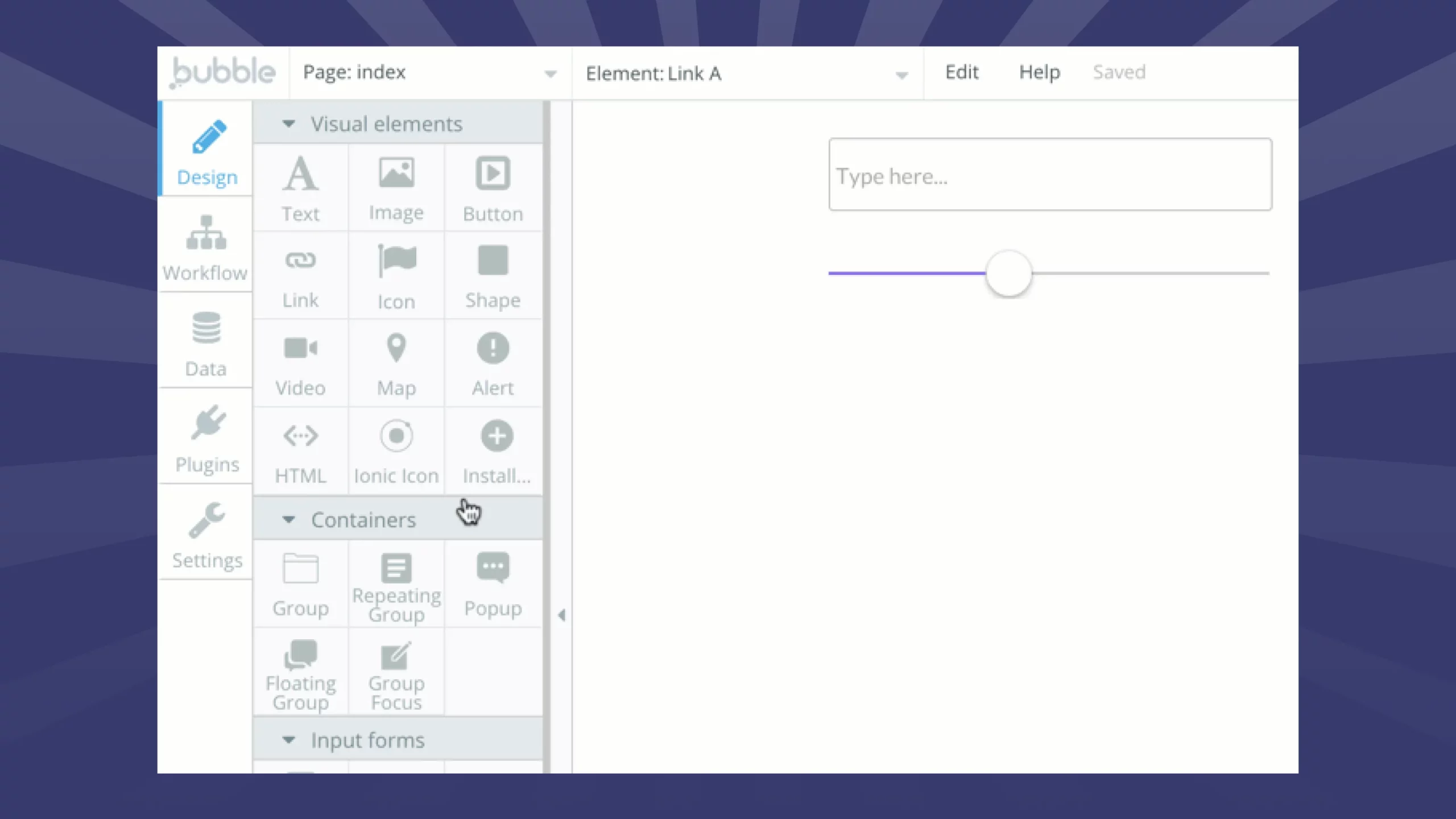
Bubble is the strongest no-code platform, which allows developing complex web applications. When starting a business, creating an MVP, or a database-based web application, Bubble is unmatched on simplicity and flexibility.
What It Does: Bubble is a full-stack visual automation platform. You design the interface, develop the database, develop workflows and deploy all on the same environment. It does not only produce prototypes but real web applications.
Key Features:
- Pixel-perfect design control: Complete freedom over UI/UX with responsive design tools
- Visual database builder: Develop structure of complex data containing relationship, constraints among data, privacy rule.
- Powerful logic builder: Conditional workflows, API calls, complex business rules, all visual.
- Built-in user authentication: Sign up, login, password reset, email verification included
- by default.
- API connector: Build with all REST APIs (Stripe, Twilio, Google Maps, custom APIs)
- Plugin marketplace: 1,000-plus community extensions enhance functionality.
- Version control: Reverting to older versions, development/live environments.
Pricing:
- Free: Bubble branding, limited capacity
- Starter: $29/month (remove branding, custom domain, more capacity)
- Growth: $119/month (sub-apps, more workflows, increased capacity)
- Team: $349/month (collaboration features, app transfer, priority support)
- Enterprise: Custom (dedicated resources, SLA, SSO)
Real-World Performance: Dividend Finance used Bubble to create their entire solar loan platform by processing more than $1 billion in loans. Teal is a career development platform that empowers 50,000+ users on Bubble. Freelance management project Comet, which had a Bubble MVP, was funded with $13M.
Best For:
- Startups building MVPs and SaaS products
- Business people developing marketplace or social sites.
- Agencies developing custom client applications
- Anyone who is in need of a database-based web app.
Limitations:
- Steeper learning curve: 2-4 weeks to proficiency.
- Performance ceiling: Complex applications may run slower; not suitable in gaming or real-time applications.
- Mobile limitations: Only progressive web applications (no native mobile apps).
- Vendor lock-in: It is hard to move and export to other platforms.
User Verdict: “Bubble let us launch in 3 months vs. 12 months with custom development. We have already reached 10,000 users without significant problems. The society is so supportive. — Founder, SaaS Startup
When to Choose Bubble:
- You’re building a web application or marketplace
- You need complete design control
- Your app requires complex database relationships
- You want to validate an idea quickly without hiring developers
When to Skip:
- You need native mobile apps (iOS/Android)
- You’re building a simple website (use Webflow)
- You need real-time gaming or video streaming features
3. OutSystems – Best for Enterprise-Grade Complex Applications
Overall Rating: 4.4/5
OutSystems is the low-code heavyweight champion – designed to support mission-critical applications, with high performance, scalability, and security, required by an enterprise. It is not the most affordable one, yet it provides enterprise performance.
What It Does: OutSystems is a web and mobile-scale application low-code platform. It integrates graphical evolution with the facility to code tailor-made code, machine learning-aided development, and enterprise-grade DevOps.
Key Features:
- Full-stack development: Front-end, back-end, database—everything in one platform
- True native mobile: Apps based on real iOS and Android and with full native capability.
- AI-assisted coding: Architecture Dashboard identifies performance problems, security issues.
- One-click deployment: Deploy to cloud, on-premise, or hybrid with zero downtime
- Enterprise integrations: SAP, Oracle, Salesforce, legacy systems—connects to everything
- Version control & CI/CD: Git integration, automated testing, deployment pipelines
- Security & compliance: SOC 2, ISO 27001, HIPAA-ready with audit logs
Pricing:
- Free: Personal environment for learning
- Standard: Custom pricing (typically $1,500+/month for small teams)
- Enterprise: $50,000-$250,000+/year depending on scale and requirements
Real-World Performance: Schneider Electric put 60 applications into use in 20 months with 253% ROI in 7 months. Ricoh has substituted its old systems realizing savings of 4.4M. The Toyota Financial Services developed a loan origination system within 4 months as compared to 18 months conventional.
Best For:
- Large enterprises replacing legacy systems
- Mission-critical applications requiring 99.9% uptime
- Organizations with complex compliance requirements
- IT teams that need low-code speed with enterprise control
Limitations:
- High cost: Not viable for small businesses or startups
- Complex licensing: Enterprise pricing lacks transparency
- Overkill for simple apps: Like using a freight truck to move a couch
- Requires training: Professional certification courses recommended
User Verdict: Out Systems enabled us to modernize our core banking system but not to write an entirely new system. The time spent on the development decreased by 70, and we were in complete control of security and compliance. — CTO, Regional Bank
When to Choose OutSystems:
- You are a huge organization with budget.
- You require high-performance scalable applications.
- You are replacing the complicated legacy systems.
- There can be no compromise on security and compliance.
When to Skip:
- Budget under $50K/year
- The construction of basic departmental tools.
- You are a new company or small business.
4. Airtable – Best for Databases, Collaboration, and Lightweight Apps
Overall Rating: 4.5/5
Airtable provides a visual representation of the spreadsheet to create a database that is also collaborative. It is the simplest method of organizing data, project management, and the creation of lightweight applications without having any technical skills.
What It Does: Airtable is a spreadsheet that is as powerful as a database. It has many views (grid, kanban, calendar, gallery, timeline), rich field types, automation, and integrations, which make it the ideal team collaboration tool.
Key Features:
- Flexible database views: Grid, kanban, calendar, gallery, timeline, Gantt chart
- Rich field types: Attachments, checkboxes, formulas, lookups, linked records, barcodes
- No-code automation: Trigger actions based on conditions (send emails, create records, update Slack)
- Interface designer: Build custom dashboards and portals on top of your data
- 2-way sync: Integrate with 1,000+ apps via native integrations and Zapier
- Collaboration features: Comments, mentions, real-time editing, permissions
- Pre-built templates: 200+ templates for CRM, project management, content calendars, inventory
Pricing:
- Free: Unlimited bases, 1,200 records per base, 2GB attachments
- Plus: $20/user/month (5,000 records, 5GB attachments, 3-month history)
- Pro: $45/user/month (50,000 records, 20GB attachments, advanced features)
- Enterprise: Custom (unlimited records, admin tools, SSO, HIPAA)
Real-World Performance: Time Magazine deals with editorial calendars on 50 or more publications. Netflix monitors projects of original production. Airtable is used by Medium to organize work on thousands of writers.
Best For:
- Task tracking and project management.
- Content calendars and editorial processes.
- CRM and lead management (minor teams)
- Tracking of inventory and assets.
- Organizing and arranging events.
Limitations:
- Not for public-facing apps: Primarily internal team tools
- Record limits: Can not work with millions of records (use real database)
- Performance issues: Slows with 100,000+ Records or complex formulas
- Limited logic: Not applicable to complex business rules or conditional workflows.
User Verdict: “Airtable has substituted 5 tools in the marketing team of our organization. We have centralized project management, content calendar, CRM and asset library in a single system” — Marketing Director, SaaS Company
When to Choose Airtable:
- You should be able to arrange information through team work.
- You need it more powerful than spreadsheets.
- You are handling projects, content or customer relationships.
- Your company has less than 100 employees.
When to Skip:
- You require a customer facing application.
- Previous No you are working with millions of records.
- You require workflows and complicated business logic.
5. Webflow – Best for Marketing Websites and Design-First Projects
Overall Rating: 4.7/5
Webflow is the dream of a designer- it is a web design tool created as a visual aid that produces clean and production-ready code. Webflow will be unrivalled in case you require a gorgeous, bespoke web site and you do not need to engage engineers.
What It Does: Webflow is an all-in-one visual design platform integrated with a high-performing CMS that enables you to build pixel-perfect responsive websites that perform and look like custom-written sites.
Key Features:
- Visual CSS control: Flexbox and grid graphical design and code-free.
- Powerful CMS: Dynamic content, collections, rich text, relationships
- Responsive design: Design for desktop, tablet, and mobile simultaneously
- Animation & interactions: Create complex animations without JavaScript
- SEO tools: Meta tags, alt text, redirects, sitemaps—all built-in
- E-commerce: Product catalogs, shopping carts, checkout (unlimited, in comparison with Shopify)
- Code export: Download clean HTML, CSS, JS for self-hosting
- Fast hosting: Cloudflare CDN, SSL certificates, automatic backups included
Pricing:
- Free: Webflow subdomain, limited CMS items
- Basic: $14/month (custom domain, 50GB bandwidth)
- CMS: $23/month (2,000 CMS items, form submissions)
- Business: $39/month (code export, 400GB bandwidth, Google Analytics)
- Enterprise: Custom (white label, priority support, dedicated account manager)
Real-World Performance: Hundreds of leading brands and Dell, Rakuten, and IDEO all rely on Webflow to create marketing sites. Agencies boast of 50-70 percent of quicker web delivery with respect to WordPress or custom code.
22Best For:
- Advertising pages and websites.
- Portfolio and agency sites
- Blogs and information-intensive websites.
- Small business websites
- Designers requiring code level control.
Limitations:
- Not for web applications: Limited logic and functionality
- E-commerce limitations: Good for small stores, not enterprise-level
- Learning curve: Designers love it, non-designers struggle
- CMS item limits: Plans cap the number of blog posts or products
User Verdict: Webflow provided one with all the design freedom without a developer. Our new marketing site was rolled out in the 2 weeks it would have taken 3 months using custom code. Responsible for engaging in different creative fields, including advertising, marketing, and more.
When to Choose Webflow:
- You are developing a marketing site or portfolio.
- You are obsessed with design and branding.
- You need control of SEO and high performance.
- You possess/desire design skills.
When to Skip:
- You require a web application that has user accounts and dashboards.
- You are developing a big online shop.
- You are inexperienced with design to the zero.
6. Mendix – Best for Multi-Cloud Enterprise Development
Overall Rating: 4.3/5
Mendix offers a change to enterprise low-code: business and IT teams work hand in hand. It is both Siemens-supported and tested and aimed at complicated enterprise apps on several clouds.
What It Does: Mendix supports fusion teams business analysts and developers that are working on the same projects. Business users are on the graphics side and the developers are on the code side but on the same platform.
Key Features:
- Dual-track development: Business analysts use Studio (no-code), developers use Studio Pro (low-code)
- Multi-cloud deployment: Deploy to AWS, Azure, Google Cloud, IBM Cloud, or on-premise
- AI-assisted development: Mendix Assist suggests next steps, catches errors, optimizes performance
- Component marketplace: Reusable modules, widgets, connectors from Mendix community
- Enterprise DevOps: Git integration, CI/CD pipelines, automated testing
- Native mobile: True iOS and Android apps with offline capability
- Comprehensive integrations: SAP, Oracle, Salesforce, REST/SOAP APIs
Pricing:
- Free: Single developer, limited deployment
- Standard: Custom enterprise pricing (typically $2,000-$5,000/month for production apps)
- Premium: Custom (includes high availability, dedicated support)
Real-World Performance: Zurich Insurance developed a global claims platform, which handles millions of claims in more than 200 countries. Philips offers healthcare applications based on Mendix to thousands of hospitals. Rotterdam City automated 50+ citizen services.
Best For:
- Companies that require multi-cloud.
- Fusion teams (business IT collaboration)
- Multifaceted applications that must be governed.
- Companies characterized by effective DevOps.
Limitations:
- High cost: Not accessible for small businesses
- Requires training: Both tracks have learning curves
- Complex licensing: App, user, and resource-based pricing
- Overkill for simple projects: More complexity than needed
User Verdict: Mendix enabled our business analysts to prototype fast as the developers created production code. In the first year, we cut our development backlog 40 percent. — VP of IT, Insurance Company
When to Choose Mendix:
- You require multi-cloud deployment solutions.
- You would like business and IT working together.
- You are developing multi-faceted enterprise software.
- You have strong DevOps and governance requirements
When to Skip:
- Budget under $50K/year
- Assembling easy departmental tools.
- You are a startup, small business.
7. Zapier – Best for Simple Workflow Automation
Overall Rating: 4.6/5
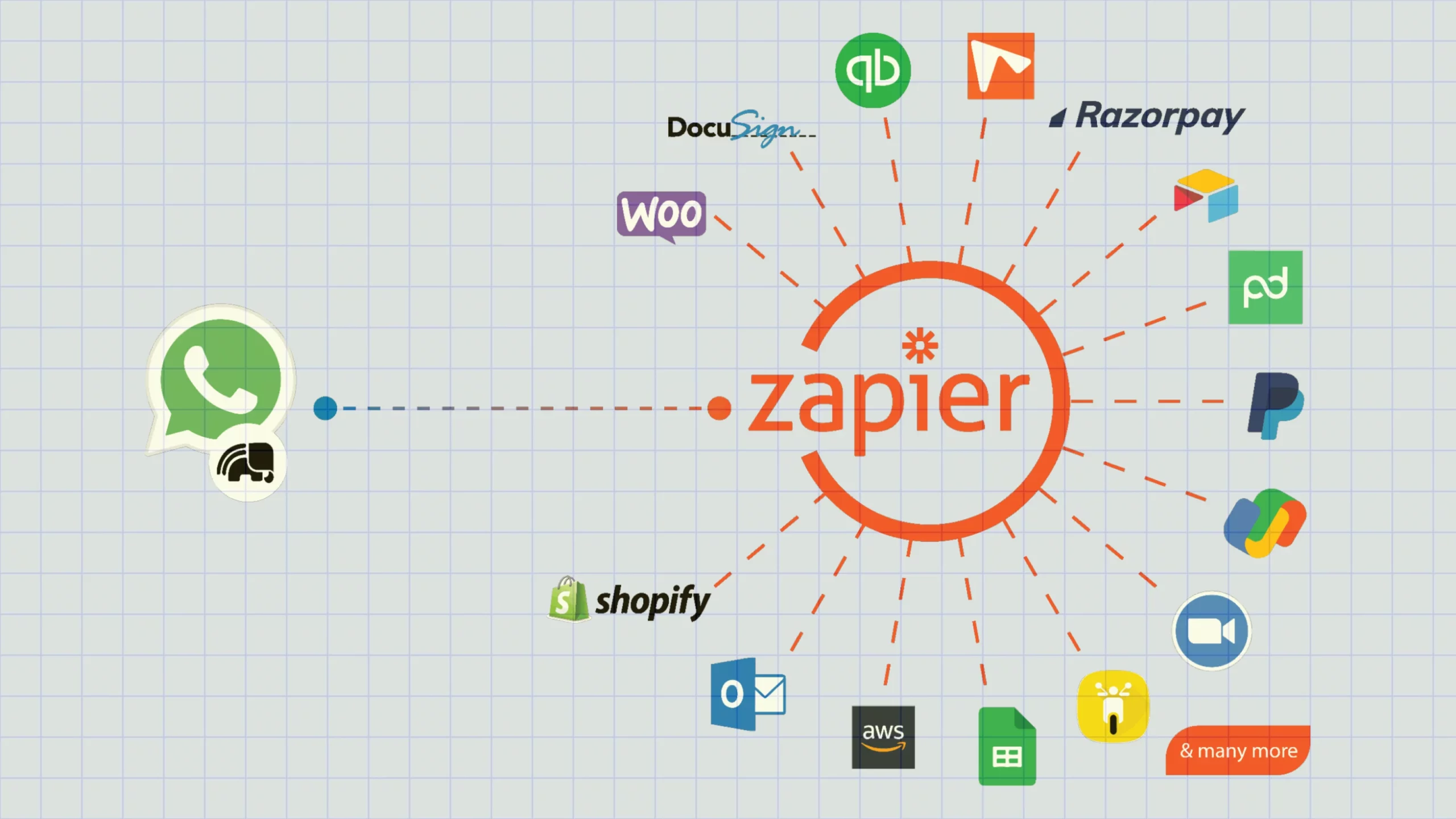
Zapier is the simplest tool to integrate your apps and automate processes without any code. It has 6,000+ integrations, which makes it the Swiss Army knife of automation, where anyone can use it and be dependent on it.
What It Does: How It Works Zapier is an app that allows you to connect apps together in the form of automated workflows. Zapier will trigger something to occur in App B, when something occurs within App A.
Key Features:
- 6,000+ app integrations: Connect virtually any SaaS tool
- Multi-step Zaps: Chain actions together (up to 100 steps on premium plans)
- Conditional logic: If/then rules, filters, paths, delays
- Built-in apps: Email, webhooks, storage, formatting, SMS
- Templates: 1,000+ pre-built Zaps for common workflows
- Scheduling: Run Zaps on schedule (daily, weekly, custom)
- Error handling: Automatic retries, error notifications
Pricing:
- Free: 100 tasks/month, single-step Zaps
- Starter: $20/month (750 tasks, multi-step Zaps)
- Professional: $49/month (2,000 tasks, unlimited Zaps, webhooks)
- Team: $299/month (50,000 tasks, unlimited users, priority support)
- Company: $599/month (100,000 tasks, advanced admin, SSO)
Real-World Performance: BuzzFeed does not distribute content manually in 30+ platforms, which saves 20 hours/week. Small-based businesses claimed a time saving of between 10-40 hours/month with regard to manual data entry and repetition.
Best For:
- Marketing automation (leads, email, social media)
- Sales workflows (CRM updates, notifications)
- Data syncing between tools
- Small business automation on a budget
- Anyone needing simple, reliable automation
Limitations:
- Gets expensive: High task volumes cost adds up quickly
- Limited data transformation: Basic filtering and formatting only
- No error recovery on free plan
- Not for complex logic: Better tools exist for sophisticated workflows
User Verdict: Zapier saves hours of man-hours of data entry. Leads that are created on Facebook Ads are automatically synced to our CRM and further to email marketing. It just works.” The job is that of a Marketing Manager, E-commerce.
When to Choose Zapier:
- You need simple, reliable automation
- You need the largest integration library.
- You’re new to automation
- You require something to work within less than 30 minutes.
When to Skip:
- You must have complicated conditional logic.
- You are handling mass (100K+ tasks/month) volumes.
- You need heavy data transformation
8. Retool – Best for Internal Tools and Admin Panels
Overall Rating: 4.5/5
Retool is developed toward developers who require building internal tools in a short time. Retool is impregnable if you are creating an admin panel, a dashboard, or a work operations tool that is connected to databases and an API.
What It Does: Retool offers ready-made parts (tables, forms, charts) which you drag onto a canvas and link them to your data sources. JavaScript allows you to create your own logic, and it is graphical programming to technical software developers.
Key Features:
- Direct database connections: PostgreSQL, MySQL, MongoDB, MS SQL, Oracle—connect directly
- 50+ pre-built components: Tables, charts, forms, maps, file uploads, timelines
- JavaScript everywhere: Write custom queries, transformations, business logic
- API integration: REST, GraphQL, any HTTP endpoint
- Version control: Git integration, deploy to staging/production
- Granular permissions: Control access down to individual components
- On-premise deployment: Self-host for maximum security and control
Pricing:
- Free: 5 users, unlimited apps
- Team: $10/user/month (unlimited apps, version control)
- Business: $50/user/month (SSO, SAML, custom branding, audit logs)
- Enterprise: Custom (on-premise, dedicated support, SLA)
Real-World Performance: DoorDash, Brex, Peloton, and Doordash use Retool for internal operations tools. Engineering teams report building internal tools 10x faster than custom coding.
Best For:
- Engineering teams building internal tooling
- Operations dashboards and monitoring
- Customer support admin panels
- Database management interfaces
- Anyone needing to quickly CRUD operations
Limitations:
- Not for public-facing apps: Internal tools only
- Requires technical knowledge: You need to understand databases and APIs
- Less design control: Components look professional but standardized
- No mobile apps: Web-only interface
User Verdict: “Retool eliminated our internal tool backlog. We went from 6 weeks per tool to 2 days. Our engineers can focus on customer-facing features instead of admin panels.” — Engineering Manager, Fintech
When to Choose Retool:
- You’re a developer building internal tools
- You need to connect to databases or APIs
- Speed matters more than custom design
- Your tools are for internal teams, not customers
When to Skip:
- You’re non-technical
- You need customer-facing applications
- You want mobile apps
9. Adalo – Best for Simple Mobile App Creation
Overall Rating: 4.2/5
Adalo makes mobile app creation accessible. If you need a straightforward mobile app without learning to code or hiring developers, Adalo gets you published to app stores quickly.
What It Does: Adalo is a no-code mobile app builder focused on simplicity. Design screens, add components, define actions—then publish native apps to iOS and Android.
Key Features:
- Native mobile publishing: Real iOS and Android apps, not just web wrappers
- Pre-built components: User profiles, lists, forms, maps, payment integration
- Built-in database: No external database setup needed
- Push notifications: Engage users with mobile notifications
- Component marketplace: Community-built components extend functionality
- App templates: Jump-start with pre-built app structures
Pricing:
- Free: Adalo branding, 50 records, limited features
- Starter: $45/month (200 records, remove branding, custom domain)
- Professional: $65/month (1,000 records, custom actions, more features)
- Business: $200/month (5,000 records, white label, priority support)
- Enterprise: Custom (unlimited records, dedicated account manager)
Note: App store publishing fees separate ($99/year Apple, $25 one-time Google)
Real-World Performance: Small businesses and entrepreneurs have launched booking apps, fitness trackers, community platforms, and marketplace apps on Adalo—typically in 2-4 weeks from idea to app store.
Best For:
- Mobile-first simple applications
- Service booking and appointment apps
- Community and social networking apps
- Fitness and wellness tracking
- Small business customer apps
Limitations:
- Performance limitations: Not suitable for data-heavy or complex apps
- App store approval: Apple can be challenging (not Adalo’s fault)
- Limited native features: Camera, Bluetooth, advanced sensors require workarounds
- Record limits: Database caps force upgrades quickly
User Verdict: “Adalo let us launch our service booking app in 3 weeks. It’s not perfect, but our customers love it and we’re processing 500+ bookings/month.” — Small Business Owner
When to Choose Adalo:
- You need a simple mobile app quickly
- Your app is straightforward (not complex)
- You want to test an idea without big investment
- You’re targeting iOS and Android
When to Skip:
- You need complex features or heavy data processing
- You want professional app store optimization
- Performance is critical (real-time, gaming, video)
10. AppSheet (Google) – Best for Google Workspace Mobile Apps
Overall Rating: 4.3/5
Now owned by Google, AppSheet turns Google Sheets, Excel, and databases into mobile apps. It’s particularly strong for data collection, field work, and offline functionality.
What It Does: AppSheet reads your spreadsheet structure and automatically generates a mobile app. You can customize views, add workflows, and deploy—all connected to your Google Workspace data.
Key Features:
- Works with Google Sheets, Excel, SQL: Connect to existing data sources
- Offline functionality: Collect data without internet, sync when connected
- Barcode scanning: Built-in scanner for inventory and asset tracking
- GPS & mapping: Location tracking and routing
- Image capture & signatures: Perfect for inspections and approvals
- Workflow automation: Approval processes, notifications, data updates
- Deep Google Workspace integration: Works seamlessly with Google Drive, Docs, Calendar
Pricing:
- Free: Personal use, limited features
- Starter: $5/user/month (basic apps, offline sync)
- Core: $10/user/month (workflows, advanced features)
- Enterprise: Custom (advanced security, support, admin controls)
Real-World Performance: Construction companies use AppSheet for site inspections, replacing paper forms and saving 10-15 hours/week. Healthcare providers use it for patient data collection in remote areas with unreliable internet.
Best For:
- Field service teams (inspections, audits, data collection)
- Delivery and logistics operations
- Construction site management
- Healthcare data collection
- Organizations using Google Workspace
Limitations:
- UI less polished: Looks functional, not beautiful
- Limited design control: Auto-generated interfaces have limited customization
- Better for internal use: Not ideal for customer-facing apps
User Verdict: “AppSheet eliminated clipboards on our construction sites. Inspectors collect data on tablets, photos automatically upload to Google Drive, and reports generate instantly.” — Operations Manager, Construction
When to Choose AppSheet:
- You use Google Workspace (Sheets, Drive)
- You need offline mobile data collection
- Field teams need mobile tools
- Budget is tight
When to Skip:
- You need beautiful, branded customer apps
- You’re not in the Google ecosystem
- Design control is important
11. Make (formerly Integromat) – Best for Advanced Automation
Overall Rating: 4.7/5
Make is Zapier’s more powerful cousin. When you require advanced automation and logic with intricate data transformation and volumes, Make can provide at a small fraction of the price.
What It Does: Make is a visual flowchart builder that allows one to create powerful automations. You get a big picture view of your workflow, can add complicated branching logic and manipulate data in a manner that is not possible with Zapier.
Key Features:
- Visual scenario builder: Flowchart interface displays the movement of data precisely.
- 1,500+ app integrations: A little less than Zapier, though including all the important ones.
- Advanced routing: Conditional logic, multitrack, error recovery.
- Data transformation: Aggregate, iterate, parse, transform data extensively
- HTTP module: Connect to any API, even without pre-built integration
- Built-in tools: Data stores, JSON/XML parsing, math operations, text manipulation
- Better pricing: 10 times lower when you need to serve a lot of customers.
Pricing:
- Free: 1,000 operations/month
- Core: $9/month (10,000 operations)
- Pro: $16/month (10,000 operations + priority support)
- Teams: $29/month (10,000 operations + team features)
- Enterprise: Custom (high volume, SSO, dedicated support)
Real-World Performance: E-commerce companies integrate stock in 10+ marketplaces, taking in 100,000+ orders per month. Complex lead scoring and distribution is automated by marketing agencies on behalf of their clients.
Best For:
- Sophisticated automation is required by power users.
- High-volume scenarios (100K+ operations/month)
- Transformational workflows that are data intensive.
- Users that are technical and API friendly.
Limitations:
- Steeper learning curve: The more powerful, the more complex.
- Less ready-to-use integrations: HTTP module will be used more frequently.
- Too much interface: The interface of flowcharts can be cluttered in large cases.
User Verdict: Make saved us 500/month over Zapier on the identical workflows. The visual builder allows one to observe what is going on without much effort and we can do things that Zapier cannot do at all. Within the company, I am an E-commerce Operations Manager.
When to Choose Make:
- It requires sophisticated conditioning.
- You are operating large volumes (price is important)
- ou’re comfortable with a learning curve
- Data transformation is important
When to Skip:
- You require the purest simplest automation
- You’re non-technical and intimidated by complexity
- You only need simple trigger-action workflows
12. Glide – Best for Turning Spreadsheets into Apps
Overall Rating: 4.1/5
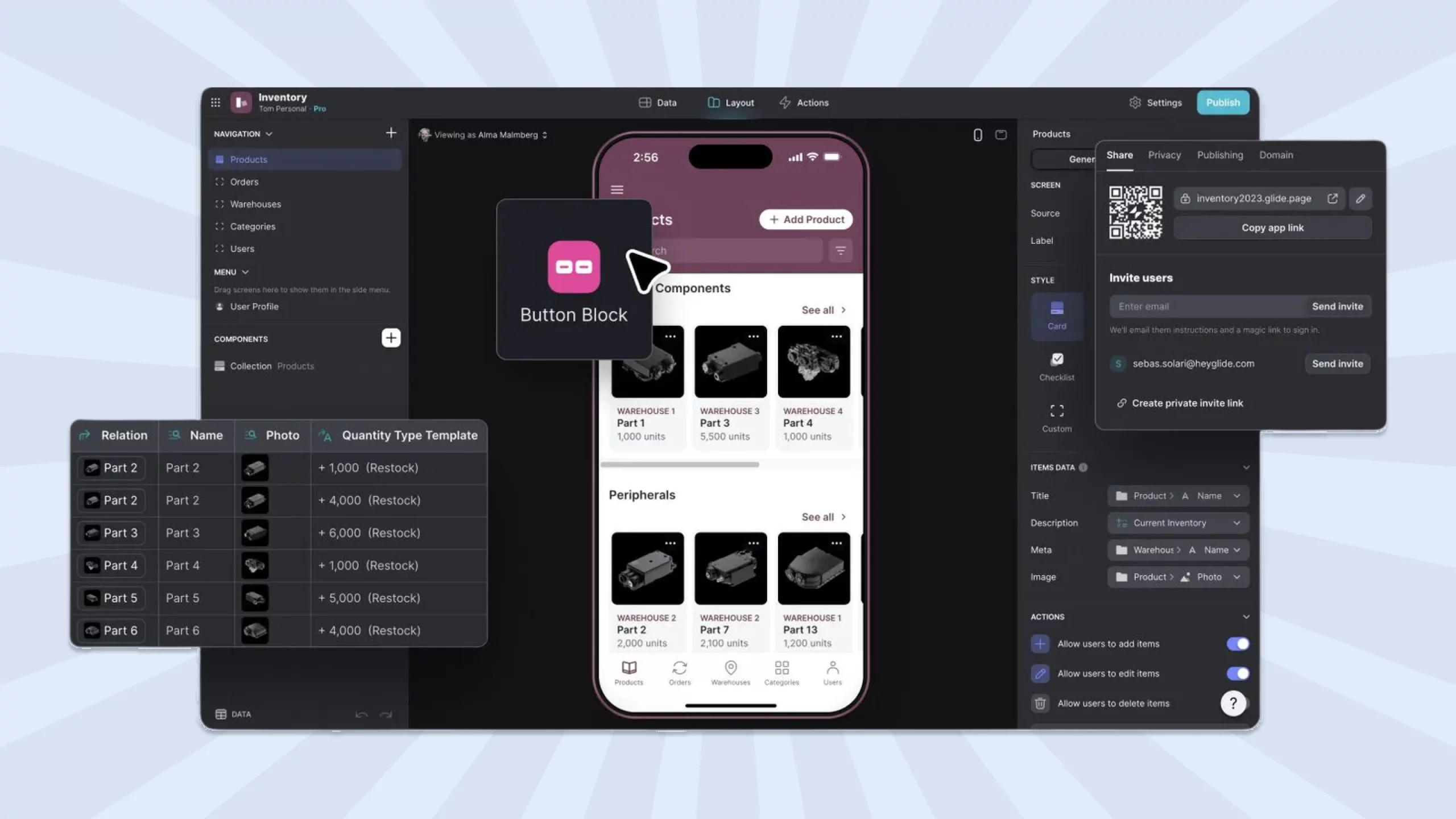
Glide does things the other way: it transforms Google sheets into Pinterest-worthy mobile applications in real-time. There is no data conversion, no complicated installation, you simply connect your spreadsheet and drive.
What It Does: Glide scans your data in Google Sheets and creates a progressive web application (PWA) automatically. It is the quickest method of converting old data into an operational mobile application.
Key Features:
- Instant app generation: Connect Google Sheets, get an app in minutes
- Beautiful templates: Pre-designed layouts for common use cases
- Progressive web apps: Work on any device through a web browser
- User authentication: Built-in sign-in with email or Google
- Real-time updates: Changes to Sheets instantly reflect in the app
- No code required: Truly accessible to anyone who can use a spreadsheet
Pricing:
- Free: Glide branding, 500 rows, basic features
- Maker: $25/month (remove branding, 25K rows, custom domain)
- Pro: $99/month (100K rows, premium features, integrations)
- Business: $249/month (white label, unlimited rows, priority support)
Real-World Performance: Nonprofits monitor volunteers and donations. Small companies develop directories of employees and inventory applications. Schools develop student portals – all based on spreadsheets that they already have.
Best For:
- Quick internal team apps
- Event management and coordination
- Team directories and contact lists
- Simple inventory tracking
- Anyone who lives in Google Sheets
Limitations:
- Tied to Sheets: Limited by Google Sheets’ data structure and performance
- Not for complex apps: Simple data display and forms only
- Progressive web apps only: Not true native mobile apps
- Limited customization: Templates look nice but similar
User Verdict: Glide created our volunteer tracking spreadsheet as a mobile app within 20 minutes. Volunteers are able to check-in, see schedules and record hours on their phones. — Nonprofit Director
When to Choose Glide:
- You have already entered your data in Google Sheets.
- You have to have something going within an hour.
- Your application is non-complex (data, forms, lists)
- You desire a low learning curve.
When to Skip:
- You require actual native mobile applications.
- Your application needs complicated logic.
- You’re working with large datasets (100K+ rows)
13. FlutterFlow – Best for High-Performance Native Mobile Apps
Overall Rating: 4.4/5
FlutterFlow is developed based on Google Flutter, developing apps that are true native and have high performance. It is the most suitable low-code solution to mobile apps that should be professional.
What It Does: FlutterFlow offers a visual builder, which generates Flutter code. The capabilities and performance of native apps are delivered with a fraction of the development time.
Key Features:
- True native apps: Real iOS and Android apps with native performance
- Visual UI builder: Drag-and-drop with Flutter’s extensive widget library
- Firebase integration: Authentication, database, storage, cloud functions—deeply integrated
- Custom code support: Write Dart code when you need more control
- API integrations: Connect to any REST API
- Real-time preview: See changes on actual devices instantly
- Code export: Download Flutter source code for self-hosting
Pricing:
- Free: Community features, FlutterFlow branding
- Standard: $30/month (remove branding, more features)
- Pro: $70/month (code export, advanced features, collaboration)
- Teams: $70/user/month (team collaboration, version control)
Real-World Performance: Indie developers have introduced apps with more than $10K dollar monthly income. Small businesses developed customer-facing applications, competing with custom-built applications at 50K -plus.
Best For:
- Businesses that require performance through mobile.
- Complex animation and interactivity Apps.
- Mobile products that face the consumers.
- Developers wanting Flutter without full coding
Limitations:
- Requires some technical knowledge: Not true no-code for advanced features
- Newer platform: Still evolving, occasional bugs
- Flutter knowledge helps: Understanding Flutter accelerates development
- App store fees: $99/year Apple, $25 Google (separate from FlutterFlow)
User Verdict: FlutterFlow reduced our time of creating a mobile app by sixty percent. Fitness tracking application: our app was developed within 6 weeks, which would have required 4-6 months to develop the same using conventional approaches. — Founder, Mobile App
When to Choose FlutterFlow:
- You require real native mobile applications.
- Performance and polish are important.
- You do not mind some technical studying.
- You would like the code export facility.
When to Skip:
- You are one hundred percent non-technical.
- You require web applications (only mobile)
- You would have the purest builder.
14. Salesforce Lightning – Best for Salesforce CRM Extensions
Overall Rating: 4.3/5 When you are using Salesforce CRM, you can extend it with custom applications, automation and workflow, all on Lightning Platform that is also in the Salesforce ecosystem.
What It Does: Lightning Platform will allow you to create your own components, apps, and automation to build on Salesforce. All of them remain unified with your CRM data.
Key Features:
- Lightning App Builder: Drag-and-drop interface for custom pages
- Flow Builder: Visual workflow automation (approvals, data updates, notifications)
- Lightning Web Components: Build custom UI components
- Einstein AI: Add AI-powered predictions and recommendations
- Mobile-ready: Built in Salesforce mobile application.
- Apex code: Write custom code when visual tools aren’t enough
Pricing:
- Essentials: $25/user/month (CRM basic plus some customization)
- Professional: $75/user/month (more customization, workflows)
- Enterprise: $150/user/month (full Lightning Platform, unlimited automation)
- Unlimited: $300/user/month (24/7 support, advanced features)
Real-World Performance: Businesses automate sales processes, customize the CRM processes, and develop industry-specific solutions without going outside Salesforce.
Best For:
- CRM users who require customization Salesforce.
- Service process and sales automation.
- Custom CRM extensions
- Companies with high investments in Salesforce.
Limitations:
- Only valuable within Salesforce: It is no use when you do not use Salesforce.
- Expensive: Licensing is extremely costly when used by large teams.
- Salesforce complexity: There is a learning curve of the platform.
User Verdict: Lightning Platform has enabled us to adjust Salesforce to our sales process. We automated approval processes that took days to complete and now they take minutes. — Sales Operations Manager
When to Choose Salesforce Lightning:
- You use Salesforce CRM
- You require bespoke CRM procedures and applications.
- Sales/service automation comes first.
- You are a believer of Salesforce ecosystem.
When to Skip:
- You don’t use Salesforce CRM
- Budget is tight
- You require applications not within the CRM stock.
15. Softr – Best for Client Portals and Membership Sites
Overall Rating: 4.2/5
Softr transforms Airtable databases into gorgeous client portals, directories, and membership sites. It is the least amount of work to build external-facing sites based on existing data.
What It Does: Softr integrates with Airtable and creates websites with user access, permission, and dynamic data- ideal to work with agencies, consultants, and membership communities.
Key Features:
- Airtable-powered: Use Airtable as your backend database
- Pre-built blocks: Lists, forms, charts, maps—drag and drop
- User authentication: Sign-up, login, password reset, email verification
- Granular permissions: Control who sees what based on user roles
- Payment integration: Stripe for subscriptions and one-time payments
- Custom domains & SEO: Professional URLs and search optimization
- Templates: Job boards, directories, client portals, membership sites
Pricing:
- Free: Softr branding, 100 records, basic features
- Starter: $29/month (remove branding, 1,000 records, custom domain)
- Professional: $79/month (5,000 records, custom code, advanced permissions)
- Business: $179/month (unlimited records, white label, priority support)
Real-World Performance: The agencies develop client portals within hours rather than weeks. Membership directories and job boards are developed by communities. Consultants create resource libraries which contain gated content.
Best For:
- Client portals for agencies and consultants
- Job boards and directories
- Membership communities
- Internal company portals (simpler than full intranet)
- Resource libraries with controlled access
Limitations:
- Dependent on Airtable: Subject to the capabilities and pricing of Airtable.
- Not for complex applications: Best when displaying content and simple forms.
- Design limitations: templates appear professional and are similar with sites.
User Verdict: Softr allows us to get a client portal in 4 hours. The clients are able to view project files, place requests, and see timelines all out of a branded portal that we created in an afternoon. — Agency Owner
When to Choose Softr:
- You are in need of a client portal or a membership site.
- Airtable has your data (or it might have your data).
- You would like something working today.
- You must have user authentication and permissions.
When to Skip:
- You need a complex web application
- You want complete design control
- Your use case doesn’t involve displaying data
Use Case Recommendations: Which Platform for What?
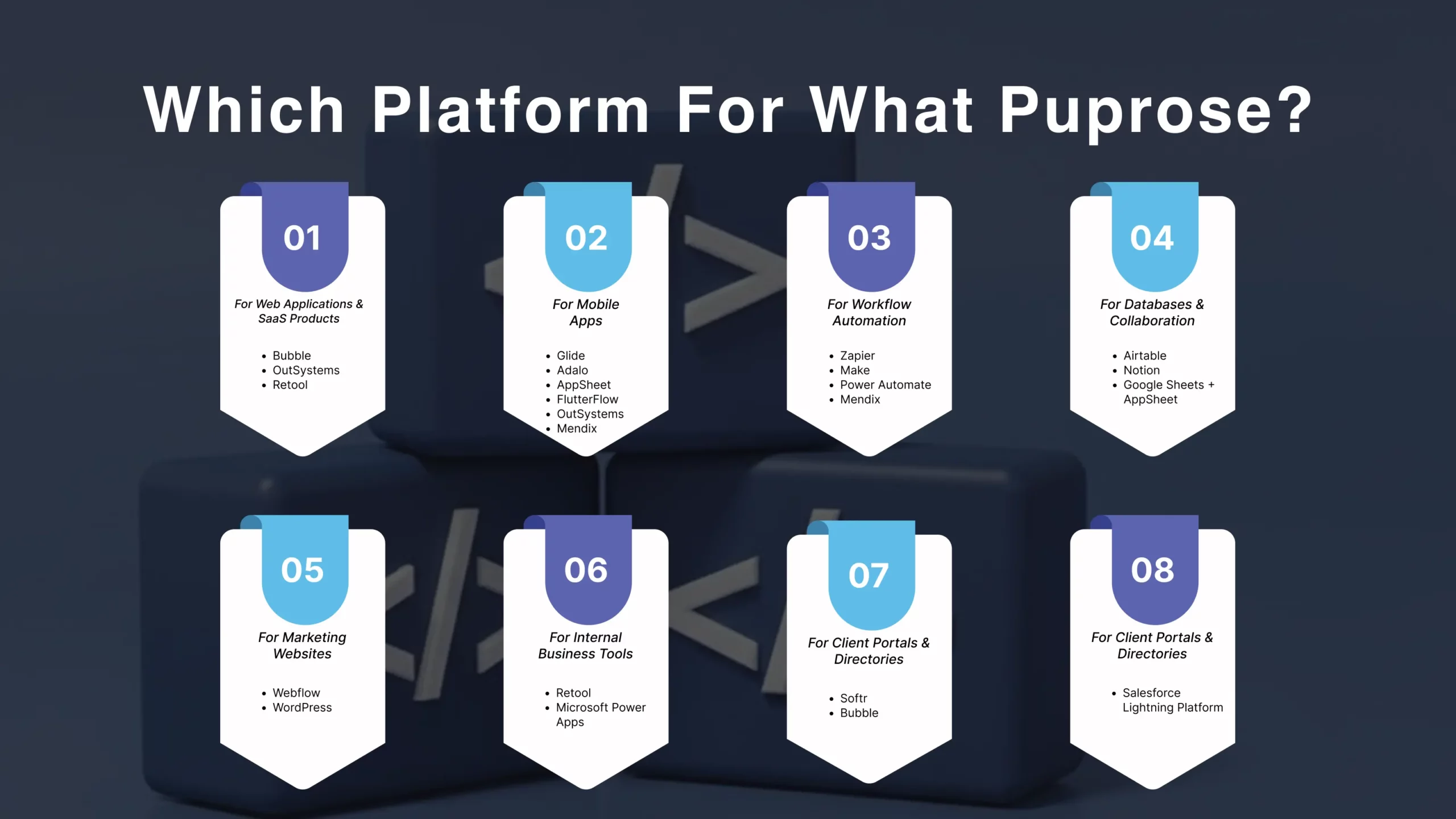
For Web Applications & SaaS Products
Winner: Bubble
Runner-up: OutSystems (enterprise), Retool (internal tools)
Choose Bubble if you’re building a custom web application, marketplace, or SaaS product with complex functionality. Choose OutSystems if you’re enterprise-scale and need maximum performance/security.
For Mobile Apps
- Simple: Glide, Adalo, AppSheet
- Performance-Critical: FlutterFlow, OutSystems
- Enterprise: OutSystems, Mendix
Choose Glide for quick internal mobile apps, Adalo for simple customer apps, FlutterFlow for polished consumer apps, and OutSystems/Mendix for enterprise mobile solutions.
For Workflow Automation
- Simple: Zapier
- Complex: Make (Integromat)
- Enterprise: Power Automate (Microsoft), Mendix\
Choose Zapier for straightforward automation, Make for power users needing complex logic, Power Automate if you’re in Microsoft ecosystem.
For Databases & Collaboration
- Winner: Airtable
- Alternative: Notion (lighter), Google Sheets + AppSheet
Choose Airtable for team databases, project management, CRM, and content management. It’s the sweet spot between spreadsheet simplicity and database power.
For Marketing Websites
- Winner: Webflow
- Alternative: WordPress (not no-code but familiar)
Choose Webflow for complete design control and fast, beautiful marketing sites. It’s unmatched for design-first projects.
For Internal Business Tools
- Winner: Retool
- Runner-up: Microsoft Power Apps (Microsoft shops)
Choose Retool if you’re a developer building internal dashboards and admin panels. Choose Power Apps if you’re heavily invested in Microsoft.
For Client Portals & Directories
Winner: Softr Alternative: Bubble (more control, more work) Choose Softr for client portals, membership sites, and directories powered by Airtable data. It’s the fastest way to launch.
For Salesforce Extensions
Winner: Salesforce Lightning Platform If you use Salesforce CRM, Lightning is the natural choice for customization and automation.
Pricing Breakdown: Total Cost of Ownership
Understanding true costs requires looking beyond sticker prices. Here’s what you’ll actually pay:
Budget Tier ($0-$100/month)
Best Options:
- Airtable: $20/user/month
- Zapier: $20-$49/month
- Glide: $25/month
- Webflow: $14-$39/month
- AppSheet: $5-$10/user/month
Hidden Costs:
- Integrations often require paid tiers
- Storage limits force upgrades
- User limits can surprise you
Mid-Tier ($100-$500/month)
Best Options:
- Bubble: $29-$349/month
- Retool: $50-$200/month (5-10 users)
- Adalo: $45-$200/month
- Softr: $29-$179/month
- FlutterFlow: $30-$70/month (plus app store fees)
Hidden Costs:
- Capacity limits (database rows, API calls, bandwidth)
- Additional environments (staging, testing)
- Premium support often necessary
- App store fees for mobile apps ($99/year Apple, $25 Google)
Enterprise Tier ($1,000+/month)
Best Options:
- Microsoft Power Apps: $5-$20/user/month (but scales to thousands)
- OutSystems: $36,300/year minimum
- Mendix: $998+/month per app
- Salesforce Lightning: $75-$300/user/month
Hidden Costs:
- Implementation and training ($10K-$50K)
- Consulting and custom development
- License true-ups and overages
- Integration and middleware costs
Total Cost of Ownership (3-Year Example)
Startup Building SaaS on Bubble:
- Platform: $349/month x 36 months = $12,564
- Plugins & add-ons: ~$1,500
- Domain & SSL: ~$500
- Total: ~$14,500 vs. Custom development: $100,000-$200,000
Enterprise Building on OutSystems:
- Platform: $150,000/year x 3 = $450,000
- Implementation: $100,000
- Training: $25,000
- Ongoing support: $50,000/year x 3 = $150,000
- Total: ~$725,000 vs. Custom development: $1.5M-$3M
Common Mistakes and How to Avoid Them
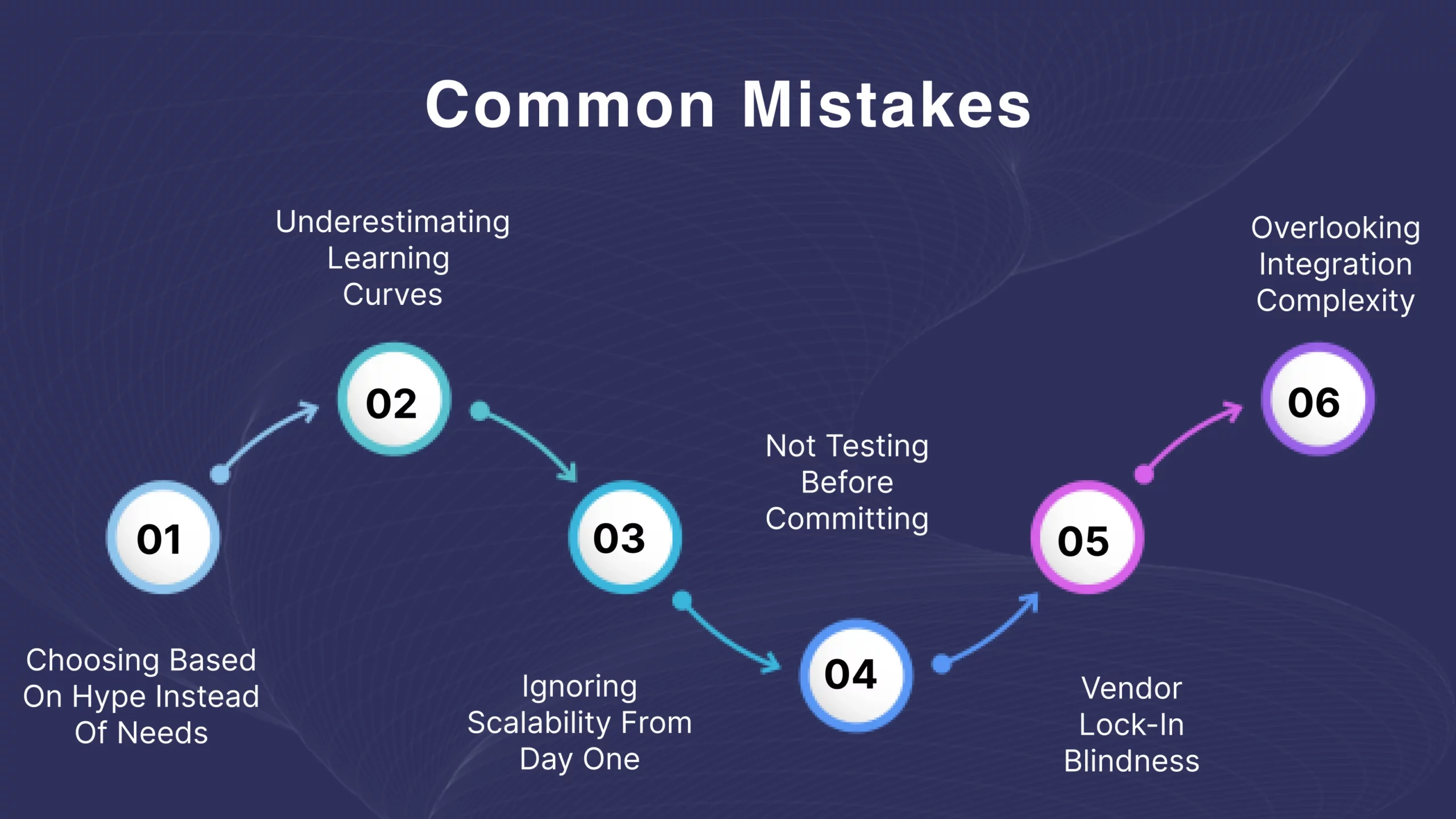
Mistake #1: Choosing Based on Hype Instead of Needs
The Problem: You read that “Bubble is the best no-code platform” and commit without evaluating if it fits your use case.
The Solution: Define your requirements first:
- What are you building? (Web app, mobile app, website, automation)
- Who will use it? (Internal team, customers, partners)
- What’s your budget? (Including time and money)
- What’s your technical skill level?
Then choose the platform that matches.
Mistake #2: Underestimating Learning Curves
The Problem: “No-code” doesn’t mean “no learning.” Even Airtable requires 1-2 weeks to master. Bubble can take 4-8 weeks.
The Solution:
- Budget 2-4 weeks learning time for any platform
- Start with tutorials before committing to projects
- Join community forums and Discord channels
- Consider hiring a consultant for initial projects
Mistake #3: Ignoring Scalability from Day One
The Problem: Your free or starter tier works great with 100 users. Suddenly you have 10,000 users and the platform can’t handle it—or the pricing becomes astronomical.
The Solution:
- Research pricing tiers beyond what you need now
- Ask about record limits, API calls, bandwidth
- Test performance with realistic data volumes
- Have an exit strategy (can you export data and code?)
Mistake #4: Not Testing Before Committing
The Problem: You read reviews, watch demos, and subscribe—then discover the platform doesn’t do what you need.
The Solution:
- Use free trials for every serious contender
- Build a small test project (3-5 hours of work)
- Test the exact features you need (not just general use)
- Evaluate customer support responsiveness
Mistake #5: Vendor Lock-In Blindness
The Problem: You build your entire business on a platform. The platform shuts down, raises prices 10x, or changes features—and you’re stuck.
The Solution:
- Check data export capabilities
- Understand code export options (Bubble, FlutterFlow, Webflow offer this)
- Read terms of service for platform stability commitments
- Have a backup plan (even if you hope to never use it)
Mistake #6: Overlooking Integration Complexity
The Problem: The platform looks great in isolation, but connecting to your existing tools (CRM, accounting, email) is painful or impossible.
The Solution:
- List every tool you need to integrate with
- Verify native integrations exist (not just “via Zapier”)
- Test API connections during trial period
- Budget time and money for custom integrations
Decision Framework: Choose Your Platform in 5 Minutes
Follow this decision tree to find your platform:
Step 1: What are you building?
- A) Marketing Website or Portfolio → Choose Webflow
- B) Web Application or SaaS Product → Go to Step 2
- C) Mobile App → Go to Step 3
- D) Workflow Automation → Go to Step 4
- E) Internal Business Tool → Go to Step 5
- F) Database/Collaboration Tool → Choose Airtable
Step 2: Web Application
Do you need pixel-perfect design control? Yes → Bubble No → Do you use Microsoft 365?
- Yes → Microsoft Power Apps
- No → Is this enterprise-critical?
- Yes → OutSystems
- No → Bubble
Step 3: Mobile App
How complex is your app? Simple (forms, lists, basic features):
- Data in Google Sheets? → Glide
- Need true native apps? → Adalo
- Use Google Workspace? → AppSheet
Medium (custom logic, integrations):
- FlutterFlow
Complex (enterprise, mission-critical):
- OutSystems or Mendix
Step 4: Workflow Automation
How complex are your workflows? Simple (trigger → action): → Zapier Complex (conditional logic, data transformation): → Make (Integromat) Enterprise (Microsoft ecosystem): → Power Automate
Step 5: Internal Business Tool
Are you a developer? Yes → Retool No → Do you use Microsoft 365?
- Yes → Microsoft Power Apps
- No → Airtable (for data-focused) or Bubble (for complex logic)
Final Recommendations: The Winner for Each Category
- Overall Best No-Code Platform: Bubble Most versatile, powerful, and capable of building complex applications without code.
- Best for Absolute Beginners: Airtable Spreadsheet-familiar interface, immediate productivity, gentle learning curve.
- Best for Enterprise: Microsoft Power Apps Security, governance, scalability, and Microsoft ecosystem integration.
- Best for Mobile Apps: FlutterFlow True native performance with visual development—best of both worlds.
- Best for Automation: Make (Integromat) Most powerful and affordable automation platform for sophisticated workflows.
- Best for Developers: Retool Fastest way to build internal tools when you have technical skills.
- Best Value for Money: Airtable or Glide Incredible functionality at accessible prices.
- Best for Design-First Projects: Webflow Unmatched design control for beautiful, fast websites.
Conclusion: Your Next Steps
The no-code/low-code revolution is not a hype, it is a complete transformation of the software construction process. These 15 platforms of the guide are the most suitable tools of 2026 and they are the best in particular situations.
Your Action Plan:
- Define Your Needs (30 minutes)
- What are you building?
- Who will use it?
- What’s your budget?
- What’s your technical skill level?
- Shortlist 2-3 Platforms (using our decision framework)
- Test Each Platform (3-5 hours per platform)
- Sign up for free trials
- Build a small test project
- Evaluate learning curve and workflow
- Test key features you need
- Make Your Decision (based on actual experience, not reviews)
- Commit to Learning (budget 2-4 weeks)
- Take platform tutorials
- Join community forums
- Build progressively complex projects
- Don’t give up in the first week
Remember: The most suitable platform is the one that is applicable to your own needs, costs, and abilities. Don’t follow what works with someone – follow what you really need to build.
The distinction between being successful and not is not the choice of the most popular platform; it is rather the choice of the right platform and the dedication to study it well.
Want to learn more about low-code and no-code development?
Check out our comprehensive guide: The Complete Guide to Low-Code and No-Code Software Development for everything you need to know about the LCNC revolution.
Ready to Build Your Application?
It doesn’t matter whether it is your first application or the fiftieth, the right platform is everything. Our team has assisted hundreds of companies to choose and implement the ideal no-code/low-code solution.
We offer:
- Free Platform Consultation: 30-minute call to recommend the best platform for your specific needs
- Implementation Support: Hands-on guidance to get your first app launched
- Training Programs: Get your team productive faster with expert-led training
- Development Services: We’ll build it for you if you prefer
Contact us today for a free consultation and let’s turn your idea into reality.
Still Confused
Which No-Code Tool Is Right for You?
You’ve seen the data, pricing, and real-world results. If you want a clear recommendation tailored to your use case, budget, and technical skill, our experts will help you choose the right platform—without costly trial-and-error.

Sandeep Kaur
No-Code low-Code Expert
Related Articles
Read expert takes on custom software development, digital trends, and real-world , growth strategies — straight from the minds at TechMarcos.

Build Faster With No-Code & Low-Code Platforms
Frequently Asked Questions (FAQs)

What is the difference between no-code and low-code platforms?
No-code platforms let users build applications without writing code, using visual builders and pre-built components. Low-code platforms allow some coding for customization and scalability, making them better for complex or enterprise-grade applications.
Which is the best no-code or low-code tool in 2026?
There is no single “best” tool for everyone. In 2026, Bubble is best for custom web apps and SaaS, Webflow for marketing websites, FlutterFlow for native mobile apps, Airtable for databases, and Zapier or Make for automation. The right choice depends on your use case, budget, and technical skill level.
Are no-code platforms suitable for building real business applications?
Yes. Modern no-code and low-code platforms are used to build production-grade business applications, including internal tools, SaaS products, customer portals, mobile apps, and automation systems used by thousands of users.
Can no-code tools scale as my business grows?
Some platforms scale very well, while others have limitations. Enterprise tools like Microsoft Power Apps, OutSystems, and Mendix are designed for large-scale usage. Tools like Bubble and FlutterFlow scale for startups and mid-sized businesses but require careful performance and cost planning.
Is no-code cheaper than traditional software development?
In most cases, yes. No-code and low-code platforms significantly reduce development time and cost. However, long-term costs depend on usage, user volume, integrations, and platform pricing tiers, which should be evaluated before committing.
Can I build mobile apps with no-code or low-code tools?
Yes. Platforms like FlutterFlow, Adalo, AppSheet, OutSystems, and Mendix support native mobile app development. Some tools like Bubble and Glide create progressive web apps instead of native apps.
Are no-code platforms secure for business and enterprise use?
Many no-code and low-code platforms support enterprise-grade security features such as role-based access control, encryption, audit logs, and compliance with standards like GDPR, SOC 2, and HIPAA, depending on the platform.