Essential Third-Party Integrations for E-commerce: Build Your Complete Revenue Stack
|
Getting your Trinity Audio player ready...
|
Developing an effective e-commerce company cannot be achieved solely through the great product and a good-looking web site. Third-party integrations provide external services that integrate external applications into e-commerce platforms’ share API, enabling the business to easily add new functionality without having to develop a new application. The contemporary online stores require a full technology stack, which can tie together payment processing, inventory management, consumer relationship applications, and analytics systems into a cohesive ecosystem.
Research states that an average tech portfolio has 269 distinct applications, and efficient management of tech stacks is a necessity. This tutorial discusses the third-party API integrations that are fundamental to a full e-commerce revenue stack that will help you to automate processes, improve customer experience, and achieve sustainable growth.
Understanding Third-Party API Integration for E-commerce
What is Third-Party API Integration?

The process of linking your e-commerce platform to other services and applications via their Application Programming Interfaces (APIs) is known as third-party API integration. It is easier, simpler and faster to add a tool that is already developed when a new feature is required as opposed to creating one that is being built. As an example, instead of coming up with your own chat solution to help the customers, you can add an already existing chat tool with APIs.
Why Third-Party Integrations Matter
The advantages of using third-party integrations to the e-commerce businesses are considerable:
Time and Cost Savings: Cost of development can be reduced and used to create special features or other business needs and the initial investment on integrations is less. The majority of API integrations are predictable and scalable, which is based on subscription plans (monthly/annually) or usage fees.
Enhanced Functionality: Third-party integrations can give business the benefit of incorporating the most useful features to ecommerce applications and the features have already been screened by the experts. It implies that you are not having to rediscover the wheel but rather build on the previously tested solutions.
Improved Customer Experience: The business can serve customers with a satisfactory shopping experience with the help of third-party integrations and generate trust with them through the alignment of data with multiple sources. The customers want to view the information they need in a convenient way and integrations provide them with this opportunity.
Scalability and Flexibility: Scalable infrastructure platform or scalability to third party solutions enables business to scale up and adjust modular architectures to new requirements.
Core Categories of E-commerce Integrations
E-commerce Platform Foundation
Your e-commerce site is the hub of all integrations. In deciding on the platform, expansion capabilities must be prioritized with a platform that must expand as sales, product portfolio and customer base do. Popular solutions such as Shopify, BigCommerce, Adobe Commerce, and Shopware have strong integration features that facilitate complete tech stacks.
Key Considerations:
- Ability to handle traffic spikes during peak seasons like Black Friday
- Native integration support for essential business tools
- API accessibility and documentation quality
- Scalability for future growth
Payment Gateway Integration
The conversion of a shopper depends on the comfort with which they can pay, and it is paramount to provide a range of safe, secure, and reliable payment methods. Failure of payment gateway may cause abandoned carts and loss of revenue.
Essential Features:
- Support of several payment methods (credit cards, electronic wallets, bank transfers)
- Security compliance (PCI DSS) industry standard.
- Fraud prevention features.
- Global payment processing for international sales
- Low transaction fees with transparent pricing
Top Payment Gateway Providers:
- PayPal: Secured and reliable worldwide with protection to buyers.
- Stripe: has big API documentation and is developer-friendly.
- Klarna: Buy now, pay later, options to get better conversion.
- Square: All-in-one payment and POS services.
Shop Pay merchants experience a 72% higher conversion rate as reported by Shopify in 2024 in the Commerce Technology Benchmark Report.
Inventory Management Systems
Multichannel e-commerce companies experience problems such as overstocking, dead air or overselling and manual inventory tracking using spreadsheets is based on piecemeal information. Integration of third-party inventory management offers real-time visibility and synchronization of the entire sales channels.
Critical Capabilities:
- Stock level tracking in real time in all channels.
- Automated reorder point messages.
- Inventory multi-warehouse management.
- Batch and serial number tracking
- Demand forecasting and analytics
Leading Solutions:
- TradeGecko (QuickBooks Commerce): B2B inventory management.
- Cin7: Omnichannel inventory and order management
- Katana: Inventory that is manufacturing oriented.
- Zoho Inventory: A part of the larger Zoho ecosystem.
Shipping and Fulfillment Integration
Shippo is a popular e-commerce third-party integration that offers API to integrate trusted shipping services, which collaborate with well-known carrier companies. Shipping integrations make it easy to deliver goods to the buyer and seller.
Must-Have Features:
- Comparison of rates among carriers.
- Automated label generation
- Real-time tracking updates
- Shipping assistance at international level.
- Automation in returns management.
Top Shipping Integrations:
- Shippo: Discounted multi-carrier shipping.
- ShipStation: Advanced automation of sellers with high volume.
- EasyShip: International shipping services including custom services.
- FedEx API: Direct integration with FedEx services for simplified delivery
Order Management System (OMS)
By incorporating an Order Management System, this will streamline selling through various channels which improves the accuracy and efficiency of integrated ecommerce strategies. An OMS integrates operations into one integrated platform.
Core Functions:
- Aggregation of orders Multi-channel.
- Order routing to fulfillment centers that are automated.
- Just-in-Time inventory synchronization.
- Tracking of orders and notifications.
- Management of returns and exchanges.
Recommended Platforms:
- Extensiv Order Manager: Integrative solution to the consolidation of ecommerce sales and inventory.
- Cin7: Omnichannel retailing solution.
- Dear Systems: Customized to small and medium enterprises.
- DSCO: Dropshipping specialized.
Customer Relationship Management (CRM)
The CRM integrations assist companies in creating a long-term customer relationship through data management, interaction tracking and marketing campaign automation. Salesforce also has an API with twitter that allows direct access to twitter to allow businesses monitor customer sentiments, offer real-time customer service and generate potential leads.
Essential CRM Features:
- Customer data centralization
- Purchase history tracking
- Automated email marketing campaigns
- Customer segmentation and targeting
- Sales pipeline management
Leading CRM Solutions:
- Salesforce: Enterprise-grade CRM with extensive third-party integrations
- HubSpot: All-in-one marketing, sales, and service platform
- Klaviyo: E-commerce-focused email and SMS marketing –Step-by-Step Klaviyo Integration Guide
- Zoho CRM: Affordable solution for growing businesses
Accounting and Financial Management
E-commerce third-party integrations make work easier in the company and allow businesses to quickly receive the required financial information, such as the data about its cost of sold products and payback period.
Critical Accounting Features:
- Automated recording of transactions.
- Generation and management of invoices.
- Calculation and compliance of taxes.
- Financial analytics and reporting.
- Multi-currency support
Top Accounting Integrations:
- QuickBooks: The accounting tool used by small and medium-sized businesses, which makes accounting and financial systems easier.
- Xero: Accounting based on the cloud, well integrated with e-commerce.
- NetSuite: Larger operation enterprise resource planning.
- FreshBooks: Simple invoicing and expenses tracking.
Marketing and Analytics Tools
Integrations between Google analytics and platforms like Shopify, Magento or WooCommerce give insights on customer behavior, referral sources and the percentage of cart abandonment.
Analytics Capabilities:
- Customer behavior tracking
- Conversion funnel analysis
- Performance of marketing campaign.
- A/B testing and optimization
- Calculation of customer lifetime value.
Essential Analytics Tools:
- Google Analytics 4: Comprehensive web analytics platform
- Hotjar: Heatmaps and session recordings
- Mixpanel: Advanced product analytics
- Segment: Customer data infrastructure platform
To measure which channels drive the most profitable traffic, marketers rely on UTM parameters for precise campaign attribution across ads, email, and social.
How to Use UTM Parameters to Track E-commerce ROI
Customer Support and Communication
CRM management systems are highly integrated and they save a lot of work done by store admin due to simplified management processes. Integrations to live chat and help desk facilitate real time customer assistance.
Support Integration Features:
- Live chat widgets
- Integration of the ticketing systems.
- Knowledge base management
- The support on the multi-channel (email, chat, social media).
- AI-powered chatbots for common queries
Recommended Support Platforms:
- Zendesk: Comprehensive customer service platform
- Intercom: Conversational relationship platform
- Gorgias: E-commerce-focused helpdesk
- Freshdesk: Affordable multi-channel support
Marketplace Integration
A retailer has to make sure that its business and its products are listed on as many online marketplaces as possible, and moving data by hand by logging into its administrative panels is its own living hell.
Marketplace Capabilities:
- Synchronization of product listing.
- Platform updating on inventory levels.
- Order import across various marketplaces.
- Optimization and pricing management.
- Per channel performance analytics.
Key Marketplace Integrations:
- Amazon Seller Central
- eBay
- Walmart Marketplace
- Etsy (for handmade/vintage items)
- Multi-channel listing tools like ChannelAdvisor
Advanced Integration Categories
Warehouse Management Systems (WMS)
The use of WMS assists Businesses in computerizing logistics, eliminating inefficiencies, and managing operations inside and outside of warehouses.
WMS Integration Benefits:
- Picking and packing processes are automated.
- Barcode tracking and scanning.
- Inventory management through location.
- Employee control and performance monitoring.
- Alliance with shipping companies.
Product Information Management (PIM)
In businesses that have large product catalogs, PIM systems concentrate on the management of product data.
PIM System Advantages:
- One place of information about products.
- Multi-currency and multi-language.
- Integration of the digital assets management.
- Enrichment processes of products.
- Distribution to various sales channels.
Returns Management
Systems enable approval of returns, processing and tracking, establish policies on returns and automatically name labels to maximize customer satisfaction and retention.
Returns Integration Features:
- Self-service return portals
- Automated return label generation
- Refund processing automation
- Return reason tracking and analytics
- Restocking workflow management
Loyalty and Rewards Programs
Customer loyalty building needs specific program administration tools.
Loyalty Program Features:
- Accumulation and redemption of points.
- Tiered membership levels
- Referral program management.
- Rewards during birthday and milestones.
- Email marketing integration.
Content Management System (CMS)
A CMS is a computer program that is deployed to create, maintain and update web site pages without a technical or programming experience. Headless CMS systems decouple content and presentation.
CMS Integration Benefits:
- Easy content updates without developer involvement
- SEO optimization tools
- Multi-channel content distribution
- Personalization capabilities
- A/B testing for content performance
Building Your E-commerce Integration Strategy

Step 1: Assess Your Business Needs
Before implementing integrations, evaluate:
- Current pain points in your operations
- Manual processes consuming excessive time
- Customer experience gaps
- Scalability requirements for growth
- Budget constraints and ROI expectations
Step 2: Prioritize Critical Integrations
What one business considers the correct integration may not be beneficial to another, so you should always question yourself what is relevant to your product and experience. Start with foundational integrations:
- Payment gateway (needed to generate revenue)
- Shipping solution (essential during fulfillment)
- Inventory (avoids stockouts and overselling)
- Basic analytics (to make decisions based on the data)
- Customer support (retention and satisfaction)
Step 3: Evaluate Integration Options
In the case of small to medium enterprises, visit app marketplaces to find low-cost add-ons, but this has its drawback: most out-of-the-box solutions are typically offered to complex integrated e-commerce such as ERP, POS, 3PL.
Integration Approaches:
Direct API Integration: Ideal use by businesses with technical resources requiring new functionality.
Pre-built Connectors: Shopify, BigCommerce, Adobe Commerce and Shopware are large competitors and highly integrating. Implantation is fast with the help of marketplace apps.
iPaaS (Integration Platform as a Service): Middleware solutions like Workato or Zapier connect multiple systems without custom coding.
Unified APIs: Providers such as Merge are services that offer a single API access to a collection of platforms of a type.
Step 4: Consider Security and Compliance
Strict privacy laws such as GDPR and CCPA exist, and companies must take care when dealing with and processing user data during integration.
Security Best Practices:
- Use OAuth 2.0 for authentication
- Implement encryption for data in transit and at rest
- Regular security audits of integrated systems
- Vendor compliance verification (SOC 2, ISO 27001)
- Data access controls and permissions management
Step 5: Plan for Scalability
Choose tools or applications that can accommodate growth, focusing on achieving goals whether an increase in sales, product range, or customer base. Consider platforms with:
- API rate limits that match your volume
- Elastic infrastructure for traffic spikes
- Pricing models that scale with usage
- Multi-region support for global expansion
Step 6: Test Thoroughly Before Launch
Poor integration or compatibility issues can lead to bad user experience, so comprehensive testing is essential to identify bugs, errors, or compatibility issues before deployment.
Testing Checklist:
- Data synchronization accuracy
- Error handling and edge cases
- Performance under load
- User experience across devices
- Rollback procedures for failures
Common Integration Challenges and Solutions
Challenge 1: Data Silos and Fragmentation
Disparate systems negatively impact order processing, collaboration, and decision-making and result in poor customer experience.
Solution: Implement a centralized data warehouse or data lake that aggregates information from all systems, providing a single source of truth.
Challenge 2: Integration Complexity
Third-party integrations designed for a specific country or region may not comply with regulations elsewhere.
Solution: Use integration platforms that handle complexity, provide pre-built connectors, and offer ongoing maintenance support.
Challenge 3: Vendor Lock-in
Depending too heavily on proprietary systems can limit flexibility.
Solution: Prioritize platforms with open APIs and standard protocols. Maintain abstraction layers in your architecture to enable easier migration if needed.
Challenge 4: Integration Maintenance
APIs evolve, and integrations require ongoing updates.
Solution: Keep integrated tools up-to-date with the latest features, improvements, and security patches to provide a consistent user experience. Consider managed integration services that handle maintenance.
Challenge 5: Performance Impact
Too many integrations can slow down your site.
Solution: Implement asynchronous processing for non-critical operations, use caching strategically, and monitor performance metrics continuously.
Integration Best Practices for E-commerce Success
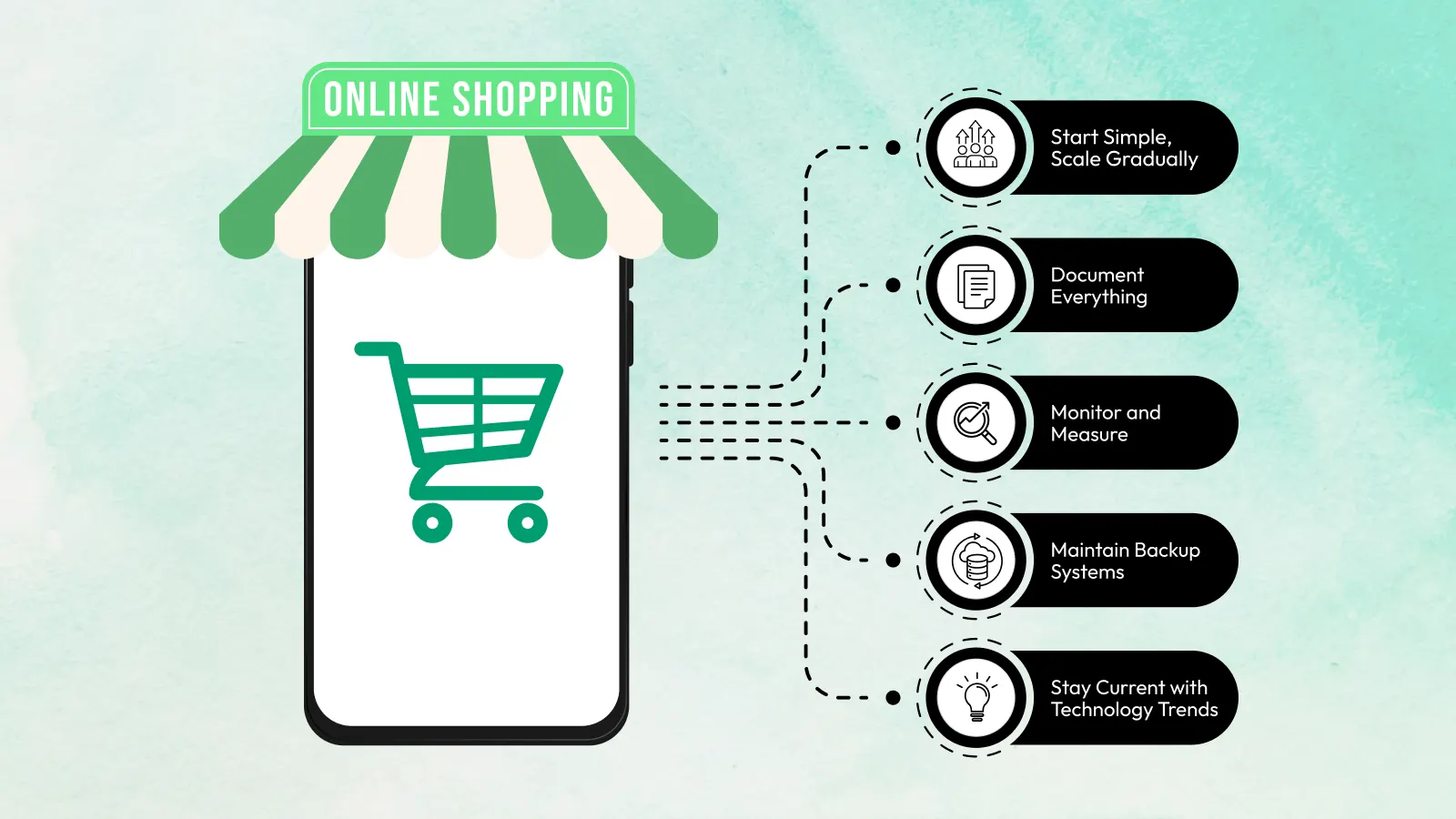
1. Start Simple, Scale Gradually
Don’t try to implement everything at once. Begin with core integrations that address your most pressing needs, then expand systematically.
2. Document Everything
Maintain comprehensive documentation of:
- Integration architecture diagrams
- API endpoints and authentication methods
- Data flow mappings
- Error handling procedures
- Vendor contacts and SLAs
3. Monitor and Measure
Implement monitoring tools to track:
- Integration uptime and reliability
- API response times
- Error rates and types
- Data synchronization delays
- Business impact metrics (conversion rates, order accuracy)
4. Maintain Backup Systems
Any mishandling or breach could lead to severe penalties and damage to the company’s reputation. Always have contingency plans:
- Backup payment processors
- Alternative shipping providers
- Manual order processing procedures
- Data backup and recovery systems
5. Stay Current with Technology Trends
The demand for composable technology is growing, with the headless commerce sector expected to reach $32.1 billion at CAGR by 2027. Keep informed about:
- API-first architectures
- Composable commerce trends
- AI and machine learning integrations
- Emerging payment technologies
- New marketplace opportunities
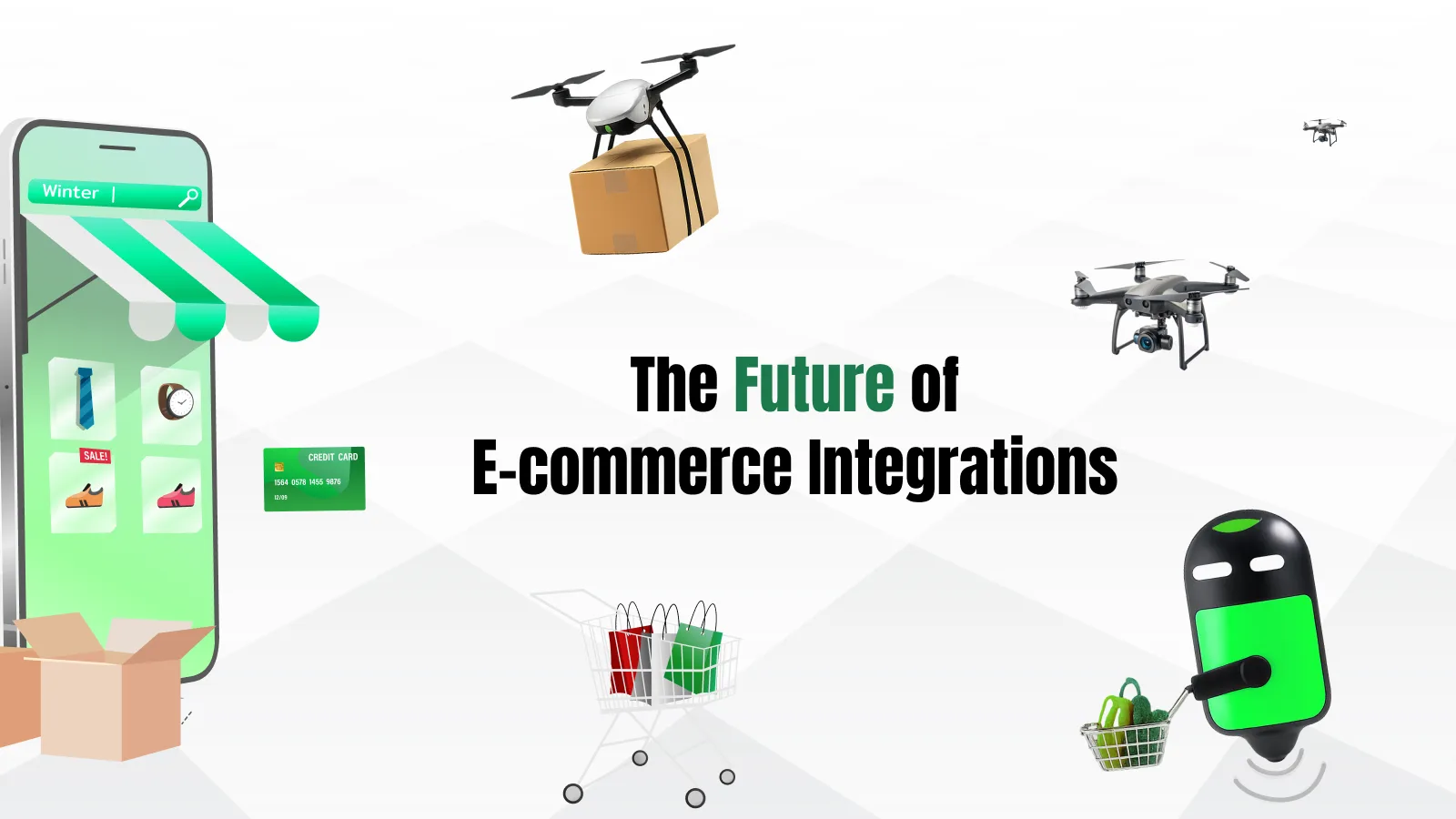
The Future of E-commerce Integrations
AI and Machine Learning Integration
Integrating AI-based solutions in composable stacks is expected to significantly increase revenue. Future integrations will leverage:
- Predictive analytics for inventory management
- Personalized product recommendations
- Chatbots and virtual assistants
- Fraud detection and prevention
- Dynamic pricing optimization
Composable Commerce
The concept of composable commerce API allows ecommerce businesses to easily integrate a range of microservices, allowing for even more flexibility. This modular approach enables businesses to:
- Select best-of-breed solutions for each function
- Replace components without system-wide disruptions
- Rapidly deploy new capabilities
- Optimize costs by avoiding vendor lock-in
Unified Commerce Experiences
According to Gartner, by 2025, there will be a minimum 20% increase in overall revenue for businesses that provide a unified commerce experience by seamlessly guiding customers across their purchasing journey.
Measuring Integration ROI
To justify integration investments, track these metrics:
Efficiency Metrics:
- Time saved on manual tasks
- Order processing speed
- Error rate reduction
- Employee productivity gains
Revenue Metrics:
- Conversion rate improvements
- Average order value increases
- Customer lifetime value growth
- Revenue per employee
Customer Experience Metrics:
- Cart abandonment rate reduction
- Customer satisfaction scores
- Net Promoter Score (NPS)
- Return customer rate
Operational Metrics:
- Inventory turnover improvement
- Fulfillment accuracy
- Returns processing time
- Support ticket resolution speed
Modern brands use advanced attribution platforms like Triple Whale to unify ad spend, customer data, and ROAS into a single dashboard.
Triple Whale for Shopify Brands
Conclusion: Building Your Complete Revenue Stack
Building a comprehensive e-commerce revenue stack through strategic third-party integrations is no longer optional—it’s essential for competitive success. The integration of strategically important third-party tools emerges as a key ingredient for sustainable success and growth in the ever-evolving e-commerce landscape.
The key to success lies in:
- Strategic selection of integrations that align with your business goals
- Careful implementation with focus on security and performance
- Continuous optimization based on data and customer feedback
- Scalable architecture that grows with your business
- Regular evaluation of new technologies and opportunities
According to McKinsey’s 2024 Digital Transformation study, 35% of commerce technology projects fail to meet objectives due to overly complex systems and tools that don’t integrate. By following the guidance in this article, you can avoid these pitfalls and build a tech stack that drives efficiency, enhances customer experience, and accelerates revenue growth.
Remember that your integration strategy should evolve with your business. Regularly assess your tech stack, eliminate redundant tools, and embrace new technologies that offer competitive advantages. The businesses that thrive in e-commerce are those that maintain agile, well-integrated systems capable of adapting to changing market conditions and customer expectations.
Start building your complete revenue stack today, and position your e-commerce business for long-term success in an increasingly digital marketplace.
Stop losing time and revenue to disconnected systems.
Our API Integration & Automation Services help unify payments, CRM, inventory, shipping, and marketing — all in one seamless ecosystem.