Cloud Cost Optimization: 6 Real Problems and How to Fix Them

|
Getting your Trinity Audio player ready...
|
Cloud costs are not long-term predictable. The more you use it, the more your bills increase in a relatively short time–someone can hardly notice until the finance sends out a red herring.
The reason why most companies are spending in excess of cloud services is not due to their irresponsibility, but it is a fact that cloud costs are hard to manage. Involved billing, scaling up fast and various stakeholders make it easy to lose track on expenditure.
Cloud cost optimization is not about cutting budgets without any consideration. It is all about becoming more visible, cutting down wastage and making a responsible choice of how your money is spent. The firms which get this right save 20-30 a year and retain or enhance the performance.
What Is Cloud Cost Optimization?
Cloud cost optimization refers to the strategic act of minimizing the costs of cloud infrastructure whilst maximizing the business value and ensuring that the performance of the applications is not compromised.
This is not the blind reduction of costs. Optimisation involves striking a balance between three things:
- Cost Efficiency: Eliminating waste and paying only for resources that deliver value
- Performance Requirements: Maintaining or improving application speed, reliability, and user experience
- Business Objectives: Adapt cloud expenditure to revenue expansion, product priorities and competitive positioning.
Cloud Cost Management vs. Optimization
- Management = Visibility and tracking (monitoring expenses, allocating costs, analyzing patterns)
- Optimization = Taking action (reducing waste, improving efficiency, maximizing ROI)
Consider management as a diagnosis and optimization as treatment. You must have the two to have sustainable cloud economics.
Key Drivers Behind Escalating Cloud Costs
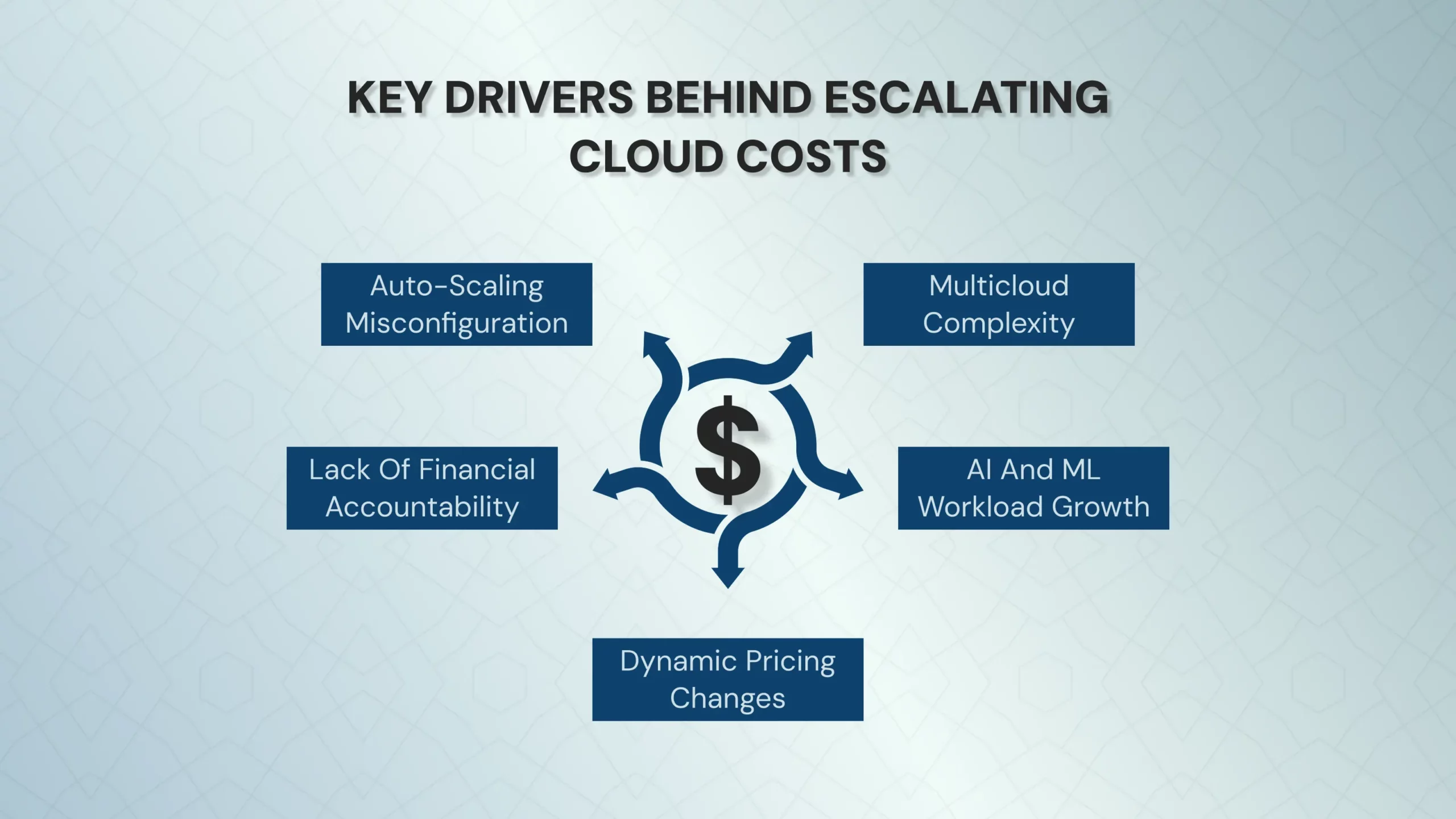
Understanding why costs increase helps you prevent them:
- Multicloud Complexity: The various cloud providers are not using the same costing strategies, the services and are not doing their operations in one and the same operational modalities and an enterprise is not allowed to operate in a single mode of managing clouds.
- AI and ML Workload Growth: The ongoing shift to AI-based services requires significant investment in cloud infrastructure, which puts the risk of unwarranted or mismanaged costs.
- Dynamic Pricing Changes: Cloud vendors keep on updating their pricing plans and introducing new features in their offerings, and thus, keeping organizations on the correct track in terms of cost-monitoring becomes a challenge.
- Lack of Financial Accountability: When there is no ownership and visibility of resources, teams revolve around them without even considering the costs and end up spending without restraint.
- Auto-Scaling Misconfiguration: Auto scaling to minimize cloud cost may be counterproductive when not set up properly and will over-provision resources during low demand times.
Top Challenges in Achieving Cloud Cost Optimization
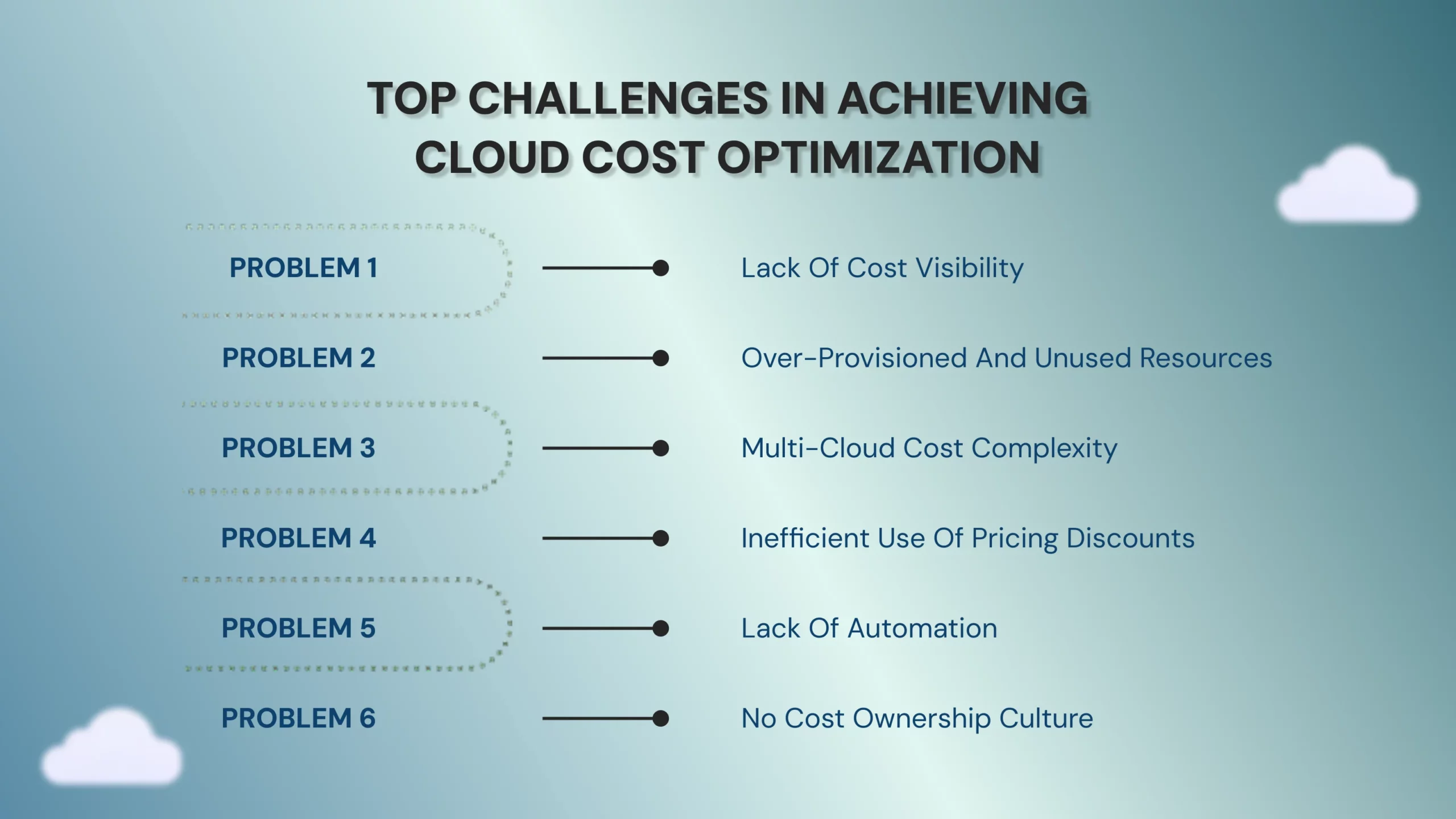
Problem 1: Lack of Cost Visibility
The Problem
Majority of teams are not aware of where their cloud money is flowing. Bills come with thousands of line items in various services, regions and accounts. Before engineering finances come in the bill, dozens more resources have been spooled up.
Unless it is visible, you will not be able to spot wasteful spending, assign costs to the appropriate teams, and make conscious future investment decisions.
Why It Happens
Complex Billing Structures: AWS itself is currently providing more than 200 services, each having its own pricing scheme. Azure and Google cloud complicate this. One application could result in charges on compute, storage, networking, databases and dozens of other services.
Poor Tagging Practices: It means that the resources are created without appropriate tags that would signify who owns them, the project, the environment or the cost center. In the case where 40-50 percent of resources are not tagged, then cost allocation cannot be properly done.
Siloed Teams: Engineering supplies resources, finance takes bills and operations looks after infrastructure, but no one has a full picture on spending across the three areas.
Practical Solutions
- Enforce Mandatory Cost Tagging
Introduce policies that make tags mandatory at the creation of resources. tag resources: At least:
- Environment (production, staging, developing, test)
- Owner or team name
- Identified project or product.
- Financial allocation cost center.
- Application or service name
Automatically deny the creation of resources without necessary tags by using cloud provider policy tools (AWS Organizations, Azure Policy, Google Cloud Organization Policy).
- Centralize Cost Dashboards
Install a single dashboard which shows the spending across all cloud accounts and providers. The dashboard shall show:
- General expenses (daily, weekly, monthly)
- Service, team, project, and environment breakdowns.
- Top 10 most costly resources.
- Budget and actual expenditure with variance alert.
- Abnormal spikes and anomalies of costs.
Open these dashboard to the engineering teams and not only finance. Interaction between real-time costs and engineers alters.
- Conduct Monthly Stakeholder Reviews
have regular meetings with the representatives of the Engineering, Finance, and Operations to review:
- Changes in spendings on a monthly basis.
- Biggest cost drivers and their appropriateness.
- Budget differences and prediction modulations.
- The identified opportunities that are still to be optimized.
Such reviews build responsibility and cost optimization is not left behind.
Problem 2: Over-Provisioned and Unused Resources
The Problem
Resources are sized in the case, “just in case”, traffic surges, just in case some performance will be impacted, just in case we will need more capacity. Test environments are built and never terminated under development teams. Projects do not end and run-offs go on. Volumes linger on even after the termination of instances in which they were called upon.
The result is this over-provisioning and sprawling of resources which silently pulls budgets. Common wastage of cloud resources is 30-40 percent of organizational investment in resources that have no business value.
Why It Happens
Fear of Performance Issues: Engineering departments are not cost-conscious. Being over-provisioned is more comfortable than the possibility of performance loss or failure.
No Regular Usage Reviews: Teams do not understand that they are running instances at 10-15% CPU utilization or having terabytes of data that are not accessed by anyone.
Lack of Shutdown Automation: Developers will code up resources on a temporary basis and fail to clean them up. An automated policy is not in place to stop these temporary resources.
Practical Solutions
- Rightsize Based on Actual Usage
Evaluate resource usage during at least 2-4 weeks to understand rightsizing opportunities:
- These are the instances using less than 40% CPU and memory usage all the time.
- Database instances that had low connection traffic.
- Load balancers with insignificant traffic.
- Low IOPS volumes in storage.
Run rightsizing guidance based on native cloud tools (AWS Compute Optimizer, Azure Advisor, Google Cloud Recommender) or third-party platforms. Begin with non-production to gain confidence before getting into production.
- Implement Automated Shutdown Schedules
Development and test environments do not need to be a 24/7 environment. Introduce schedules that will automatically:
- Close non-production cases outside working hours (6 PM -8 AM)
- Shut down of resources on weekends.
- Set idle environments after 3-7 idle days.
In a typical development environment which operates 24/7, costs are cut by 65-70 by not having to go down on weekends and overnight only.
- Remove Unused Resources Systematically
Establish automated policies and manual reviews to eliminate:
- Unattached EBS volumes: Volumes which were previously in use but are currently idle.
- Obsolete snapshots: Backups that are older than retention policies demand.
- Unused Elastic IPs: IP addresses which are not linked to running instances.
- Orphaned load balancers: Load balancers that have no targets or traffic.
- Forgotten databases: Database instances whose incoming connections are less than or equal to 30 days.
Conduct quarterly audits to detect and discontinue resources not used within 90+ days.
Problem 3: Multi-Cloud Cost Complexity
The Problem
The experience of cost management in AWS, Azure, and Google Cloud is comparable to managing three budgets with three accounting systems. The various providers have various words to denote the same kind of services, varying billing periods, varying discounting systems and various costing allocation systems.
The problem of cloud spending spread across various providers in different organizations puts them out of sight and control. Recent studies indicate that currently, 89% of companies utilize multiple cloud platforms, yet most of them have a hard time tracking costs in a single place.
Why It Happens
Different Billing Models:AWS is charging data transfer out, Azure is offering some egress in its cost tier, Google Cloud is taking another path. Providerwise, the Reserved Instance commitments are of varying behavior. Discount structures vary.
No Unified Cost View: Native tools provided by individual providers only display the amount they spend on that particular platform. Finance is presented with three distinct bills, which have unsuitable formats and terms.
Fragmented Ownership: There are many times when various teams represent different clouds, and a team takes care of AWS, the other manages Azure. In absence of centralized control, no one observes the total amount of spending in the clouds across platforms.
Practical Solutions
- Use a Centralized Cost Management Platform
Implement a cost management tool which will consolidate spending together across all the providers into a single view. Look for platforms that:
- Standardize cost data between AWS, Azure, and GCP.
- Offer single tagging and allocation.
- Present actual apple-to-apple cost comparisons.
- Produce consolidated financial reports.
CloudHealth, CloudZero, Flexera, Apptio Cloudability or IBM Turbonomic can be the option.
- Standardize Reporting Across Providers
Create a standardized format of reports irrespective of cloud provider:
- Same cost categories (compute, storage, networking, etc.)
- Standardize reporting dates (monthly reporting of all providers)
- Use identical allocation techniques (team, project, product)
- Measure the same KPIs (cost per customer, cost per transaction).
This standardization allows contribution to meaning comparisons and budget planning.
- Assign Clear Ownership Per Cloud Environment
Assign certain people or teams to manage the cost of each cloud platform, yet establish a single central team called FinOps that manages all cloud expenditure. This structure provides:
- Specialized expertise of the platform to be optimized.
- One common government and one common law.
- One point of accountability of total cloud expenses.
- Sharing of best practices across platforms.
Problem 4: Inefficient Use of Pricing Discounts
The Problem
Cloud service providers provide substantial discounts in the form of Reserved Instances, Savings Plans and committed use contracts- 40-70% off the on-demand pricing. These engagements diminish the ability to be flexible. Organizations either commit excessively to save cost and lose it through paying unused capacity, or underspend and miss on the saving.
The situation is aggravated by poor forecasting. Business requirements evolve, workloads vary and commitments that were bought last year do not conform to current requirements.
Why It Happens
Inaccurate Usage Predictions: It is hard to predict cloud usage in 1-3 years. The effect of product pivots, customer expansion and architectural alterations all influence resource needs in an erratic fashion.
Business Needs Change: That predictable work load you promised? Your company has just shifted it to serverless. The reservation you made capacity of? This was closed down by the business unit.
All-or-Nothing Thinking: Teams do not make commitments at all since they are worried about being tied down or they make maxitax commitment to reservations so that they can save a lot but leave no room whatsoever.
Practical Solutions
- Use Commitments Only for Stable, Predictable Workloads
Analyze 90-180 days of historical usage to get actual stable baseline workloads:
- Production applications that have regular traffic patterns.
- Data processing systems and always on databases.
- Infrastructure services that are not going to change in the near term.
Only reserve capacity against these workloads of the base – usually 40-60 % of your total usage. The rest can be covered by on-demand or spot instances.
- Review Reservation Usage Quarterly
Do not consider Reserved Instances to be a set and forget. Carry out quarterly reviews which investigate:
- Utilization levels of current reservations (target 90 and above utilization)
- Increased workloads and possible to be enhanced with extra reservations.
- Underutilized reservations, which need to be changed or retailed.
- Future reservation expiries requiring renewal.
Cloud providers will also enable you to update, trade or sell reservations in the secondary markets in case of change of needs.
- Balance On-Demand, Reserved, and Spot Pricing
Create a hybrid strategy that balances cost savings with flexibility:
- Reserved Instances/Savings Plans (40-60% of capacity): Cover predictable baseline workloads
- On-Demand (20-30% of capacity): Handle variable workloads and burst capacity needs
- Spot Instances (10-30% of capacity): Run fault-tolerant workloads like batch processing, CI/CD, and non-critical services
This balanced approach reduces costs without over-committing to long-term contracts.
Problem 5: Lack of Automation
The Problem
Cloud cost optimization cannot be done manually. In the event that engineers peruse costs weekly, explore the manner of use, detect waste, and execute remedies by hand, the entire procedure is time-consuming and unreliable in terms of its outcomes. No sooner than an optimization cycle is completed is there another waste that is generated.
Companies that use manual processes generally optimize in a reactive manner (reacting to budget alerts and unexpected bills instead of avoiding waste before it happens).
Why It Happens
Teams Rely on Manual Checks: Lacking automated mechanisms, cost optimization is based on individuals recalling to look at spending, analyze usage and act, all competing with feature development and operational priorities.
No Automated Policies in Place: Cloud environments do not have policies, which automatically impose cost controls, and all decisions are made at will and by humans.
Fear of Automation Breaking Things: Teams fear that an automated shutdowns or scaling policy can affect production systems, so they never formulate any policy of automation at all instead of cautiously adopting it.
Practical Solutions
- Enable Intelligent Auto-Scaling
Set auto-scaling policies: This will scale resources automatically according to the actual demand: For compute resources:
- Auto-scale on surpassing CPU, memory or custom metrics thresholds.
- Reduce aggressively in times of low demand (do not over-provision in case of overkill)
- Predictive scaling should be used when possible on past patterns.
- Provide limits of maximum costs to avoid runaway costs.
For databases:
- Portable autoscale read replicas by connection counts.
- Auto-scale storage increases with data.
- Use serverless database when the workload is variable.
- Automate Cleanup of Unused Resources
Install automatic policies which diagnose and remove waste without using human hands:
- Unused volumes: Auto-destruct unattached EBS volumes in 7-30 days.
- Old snapshots: Delete snapshots that are older than retention policies (e.g. 90 days)
- Idle instances: Flag or shut down instances with less than 5% CPU utilization of 7 days or longer.
- Forgotten resources: Notify when a resource has not been used in 30+ days, delete after 60 days.
- Non-production environments: Automatically shut down dev/test resources after business hours.
Begin with notifications and manual validation and move towards the full automation of deletion.
- Set Cost Alerts and Budget Thresholds
Ensuring automatic alerting to alert teams before spending is an issue:
- Budget alerts: Notify when spending reaches 50%, 75%, 90%, and 100% of budget
- Anomaly detection: Alert on spending spikes that deviate from normal patterns
- Service-specific alerts: Monitor expensive services independently
- Team-level alerts: Send cost notifications to the teams responsible for the spending
Integrate alerts with Slack, email, or ticketing systems your teams already use.
Problem 6: No Cost Ownership Culture
The Problem
Cloud costs get treated as “someone else’s problem.” The budget is assumed to be managed by the engineers. Finance presupposes engineering to take control of infrastructure. Operations is concerned with maintenance of systems. No one feels personally responsible for cloud spending.
Lack of ownership and accountability leads to failure of optimization efforts. Even in situations where people can detect the opportunities of saving, they do not have the power or will to change.
Why It Happens
Engineering and Finance Work in Silos: Engineering engineers make technical decisions on architecture and usage of resources without regard to costs. Finance is the one that observes the bills without having a technical context to question spending or propose alternatives.
No Incentives for Cost Consciousness: Performance reviews and team goals revolve around features delivered and uptime and incidents fixed, but not on cost efficiency. What is the point of engineers making optimization a priority when it does not impact their success metrics?
Lack of Visibility: Engineers will fail to make cost-conscious decisions even when they would have liked to do so due to lack of visibility about the costs their decisions will cause.
Practical Solutions
- Share Cost Reports Transparently with All Teams
Bring cloud costs to view of all those who affect expenditure, not the finance alone:
- Present team-specific cost boards in engineering areas (Slack channels, wiki pages, team rooms)
- Embody cost information in planning and sprint review meetings.
- Display trend of show costs and velocity, and quality measures.
- Emphasize both negative (what made costs high) and negative (optimization wins) improvements.
When engineers look at daily costs, they automatically begin to pose a question of why is it expensive? and “how can we reduce this?”
- Assign Clear Cost Ownership
Identify specific cost management owners per service, application and business unit:
- Products have costs that belong to product teams.
- Platform teams assume a common cost of infrastructure.
- Each engineering manager is in charge of its expenditure.
- Planning and policy execution: FinOps team is the owner of the general cloud budget.
Ownership implies the right to make optimization-related decisions, as well as the accountability to remain within the allocated budgets.
- Involve Finance and Engineering Together
Build cross functional cooperation by:
Weekly or bi-weekly FinOps team meetings with representatives from:
- Engineering (2-3 senior engineers of various groups)
- Finance (financial analyst or controller)
- Infrastructure (lead) or SRE Operations (lead)
- Product (product manager major applications)
Shared objectives and metrics:
- Cost per customer/transaction (engineering and finance both are concerned)
- Waste percentage (per cent of expenditure on idle or unused resources)
- Budget variance (real and projected expenditure)
- Remediation time to anomalies in costs.
Joint decision-making authority: The team of FinOps must be empowered to make optimization decisions up to a set level (i.e. $50,000) without going to the supervisor.
Recognition and incentives: Incorporate cost efficiency in performance meetings. Praise teams which reduce cost per customer and preserve quality. Divide share savings among the teams that make large cuts.
Best Practices Summary

The Bottom Line
Cloud cost optimization is not a project but a daily operation practice that needs to be visible, automated and held accountable.
Firms that go about optimization methodically achieve steady outcomes: 20-30 percent cost savings in the initial year, 15-20 percent annual savings thereafter, and engineering departments that would inherently think about costs when deciding on architecture.
The key is starting small. Select one of the issues in this guide, such as, the absence of visibility, or the wasted resources and apply the realistic solutions within the next 30 days. Track the results. Then tackle the next problem.
Minor gains add up to huge savings. And it is unlike most technical debt because cost optimization provides measurable ROI that is realized immediately and realized by business leaders.
Take Action This Week
If you have 2 hours:
- Deploy cost dashboards for your top 3 teams
- Implement automated shutdown for one non-production environment
- Identify your top 10 most expensive resources and verify they’re all necessary
If you have 1 day:
- Audit and tag all untagged resources
- Set up budget alerts at 75%, 90%, and 100% thresholds
- Schedule your first monthly cost review meeting
If you have 1 week:
- Analyze 30 days of usage data and generate rightsizing recommendations
- Implement automated cleanup policies for unused volumes and snapshots
- Create a FinOps team with representatives from Engineering, Finance, and Operations
The sooner you start, the faster you stop wasting money.
Frequently Asked Questions (FAQ) for Cloud Cost Optimization
What are the three main cloud cost challenges?
Three prevalent issues with the cloud costs are the absence of cost visibility, ineffective resource utilization and the absence of the clear ownership of costs. Cloud spending is increasing at an unsustainable pace when teams do not have visibility or understanding of money flow, oversized resources, and lack accountability.
What are the major challenges faced in cloud computing?
Cost-wise, the largest obstacles of cloud computing are multifaceted pricing strategies, unmanaged scaling, multifaceted cost fragmentation across multiple clouds, misconfigured automation, and ineffective cooperation between the engineering and finance departments. Out of these, cost control is normally the most economically harmful problem to organizations.
What is cost optimization in cloud computing?
Cost optimization in cloud computing is the continuous activity of lowering the cost of the cloud infrastructure without compromising on the performance, dependability and business results. It dwells on waste elimination, resource right-sizing, appropriate pricing models, and business priorities alignment of cloud spending.
What are the biggest challenges in reducing cloud costs?
The challenges that appear to be the most significant in terms of reducing cloud costs are fear of production performance impact, incorrect predictions regarding the necessary elected capacity, manual optimization, a low level of automation, and absence of incentives encouraging engineers to focus on cost-effective agendas.
Why do cloud costs increase unexpectedly?
Unexpected costs of clouds are typically observed with the rapid scaling, unscheduled or idle resources, multi-cloud complexity, the growth of AI/ML workloads, the changes of cloud prices, and the subpar financial responsibility across teams.
Is cloud cost optimization a one-time activity?
No. Cloud cost optimization is not a one-time process of operation. With the changing usage patterns, workloads, and business requirements, cloud environments demand continuous monitoring, automation, and governance to avoid the waste and ensure efficiency. If you want to turn these cloud cost optimization ideas into measurable savings, our experts can help you implement, automate, and manage cloud costs efficiently across your environment.